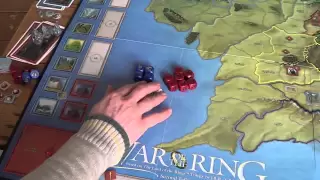
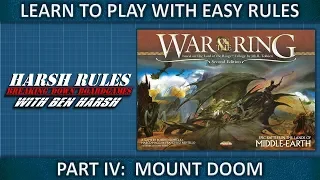
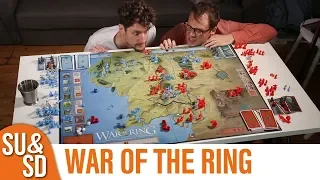
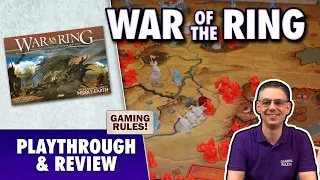
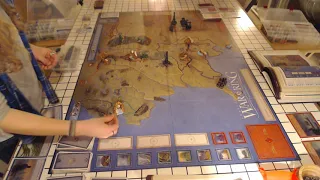
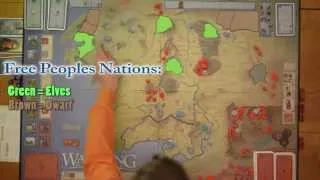
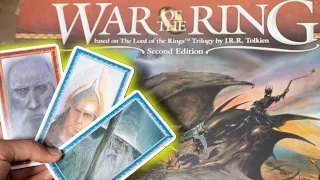
Watch “How to Play War of the Ring in 28 Minutes,” a how-to-play guide for War of the Ring: Second Edition from RTFM on BoardGameVideo.
Description provided by RTFM on YouTube:
Learn how to play War of the Ring in just 28 minutes (there's a bit of silliness at the front and back)
Intro - 0:00
Set up - 2:40
Basics/Phases of play - 4:56
Action Resolution - 5:46
Palantir action - 6:34
Army action - 7:12
Muster action - 7:38
Character action - 9:25
Other actions - 11:30
Elven rings - 12:17
Politics - 13:09
Movement - 15:05
Battle - 17:04
Hunt for the Ring - 23:16
Doom Track - 28:12
Outro - 30:01
Big thanks to The Brothers Murph for helping out! You should absolutely check out their channel http://youtube.com/thebrothersmurph and send them some love. They put out great videos all the time and are just the best.
To support RTFM, consider pledging at http://patreon.com/RTFM
Want to buy this game? Get it here https://amzn.to/2CSqv7H and it'll kick back a few bucks to me (or go to your friendly local game store, that's cool too)
Corrections:
When retreating into a siege, excess army units are placed in your reinforcements instead of being left on the field. (Thanks to Sean McConnell for spotting that one)
To be clear, Mt. Gundabad and Dol Guldur are Sauron strongholds, so you can also recruit Nazgul there.
I said that characters can't enter friendly strongholds if they're under siege, but neglected to mention that they also can't leave their besieged strongholds. And The Mouth of Sauron has the same siege-movement limitations as characters.
Another just-in-case clarification: when gaining hunt re-rolls based on the Fellowship being in a region with enemies/shadow strongholds/nazgul, these still don't stack, meaning that three re-rolls gained can let you re-roll up to three dice, but not one die three times. (Thanks to RealZelyet for pointing this out)
Not really a rules clarification, but I say that there are shadow cards that are worse if Gollum is the guide, when in reality those cards are mostly just different if not better. The real danger in Gollum leading you is that there's no one else to take the hits.
Twitter: http://www.twitter.com/rtfmshow
Instagram: http://www.instagram.com/rtfmshow
Personal Twitter: http://www.twitter.com/sheasayswords
2011·Roberto Di Meglio, Marco Maggi, Francesco Nepitello
Videos
134
Creators
64
Mainly playthroughs. War of the Ring: Second Edition is covered on BoardGameVideo.com by 29 reviews, 26 how-to-play guides, 56 recorded sessions, 6 unboxings, and 17 other videos.
2 - 4 players
150 - 240 min
Very heavy weight: Rules-dense, long sessions
About War of the Ring: Second Edition, from BoardGameGeek:
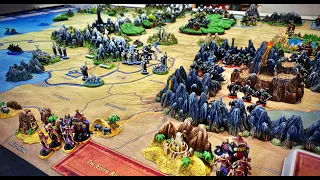
In War of the Ring, one player takes control of the Free Peoples (FP) while the other player controls Shadow Armies (SA). Initially, the Free People Nations are reluctant to take arms against Sauron, so they must be attacked by Sauron or persuaded by Gandalf or other Companions before they start to fight in earnest: this is represented by the Political Track which shows if a Nation is ready to fight in the War of the Ring or not.
The game can be won by a military victory if Sauron conquers a certain number of Free People cities and strongholds, or vice versa. But the true hope of the Free Peoples lies with the quest of the Ring bearer: while the armies clash across Middle-earth, the Fellowship of the Ring is trying to get secretly to Mount Doom to destroy the One Ring. Sauron is not aware of the real intention of his enemies but is looking across Middle-earth for the precious Ring, so that the Fellowship is going to face numerous dangers, represented by the rules of The Hunt for the Ring. But the Companions can spur the Free Peoples to the fight against Sauron, so the Free People player must balance the need to protect the Ring bearer from harm with an attempt to raise a proper defense against the armies of the Shadow so that they do not overrun Middle-earth before the Ringbearer completes his quest.
Each game turn revolves around the roll of Action Dice: each die corresponds to an action that a player can perform during a turn. Depending on the face rolled on each die, different actions are possible (moving armies or characters, recruiting troops, advancing a Political Track).
Action Dice can also be used to draw or play Event Cards. Event Cards are played to represent specific events from the story (or events that could possibly have happened) that cannot be portrayed through normal game-play. Each Event Card can also create an unexpected turn in the game, allowing special actions or altering the course of a battle.
Designers
Roberto Di Meglio, Marco Maggi, Francesco Nepitello