



Light Seeker

Light Seeker

2024Daniel Danzer, Julian Danzer

2 players
5 - 15 min
1.5/5 weight

From BoardGameGeek

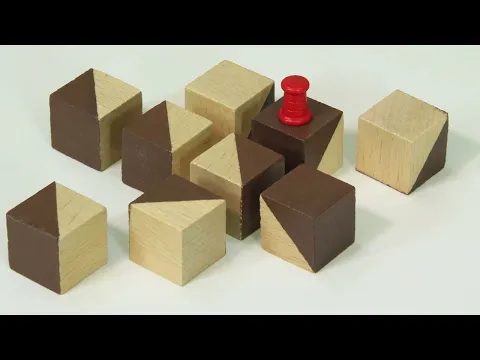
In Light Seeker, both players must increase the amount of light in the world on their turn - but can you bring the light together to win? To set up, place the nine cubes in a 3x3 grid with space between the cubes and with dark sides on top, then put the blocking token onto the central cube. Each cube has two sides that are all dark, two sides that are half-light (diagonally separated into a dark and a light triangle, marked with a white dot), and two sides being fully light (with a white dot on each triangle). Each light triangle counts as 1 light, so a fully light side counts as 2 light. The starting player tilts one cube into an open space and places Buh, the blocking token, onto any other cube, then the second player starts with the first normal turn. On a turn, you take two actions. An action can be to (1) slide a cube into an orthogonally adjacent open space, not changing its orientation, or (2) tilt a cube into an orthogonally adjacent open space. You cannot take an action where Buh is located, and after taking your actions, you must move Buh onto any other cube. At the end of your turn, all cubes must be orthogonally or diagonally adjacent to at least one other cube and the total amount of light on the top faces of the cubes must have increased. A "light area" is created by one or more cubes that have orthogonally (edge to edge) adjacent half or full Bright faces. Multiple light areas can exist on top of the cubes, and they will shift and change over time. If at the end of your turn, you have created a light area that contains at least 7 light, you win.

Watch first

Creators who cover this

Bower's Game Corner
Bower's Game Corner
1 video of this game
Daniel Danzer
Daniel Danzer
1 video of this game
Merry Married Meeples
1 video of this game

Games like this

2017Dane Beltrami, Corey Konieczka, Christian T. Petersen

Videos
363
Creators
124
Mainly how-to-play and playthroughs

3 - 6 players240 - 480 min4.4 weight

2021Randy Flynn

Videos
318
Creators
247
Mainly reviews and playthroughs

1 - 4 players30 - 45 min1.8 weight

1985Don Greenwood

Videos
264
Creators
23
Mainly how-to-play

2 players120 - 480 min4.7 weight

2023Maxime Tardif

Videos
203
Creators
146
Mainly reviews

1 - 5 players45 - 90 min2.9 weight

About Light Seeker

From BoardGameGeek:

In Light Seeker, both players must increase the amount of light in the world on their turn - but can you bring the light together to win? To set up, place the nine cubes in a 3x3 grid with space between the cubes and with dark sides on top, then put the blocking token onto the central cube. Each cube has two sides that are all dark, two sides that are half-light (diagonally separated into a dark and a light triangle, marked with a white dot), and two sides being fully light (with a white dot on each triangle). Each light triangle counts as 1 light, so a fully light side counts as 2 light. The starting player tilts one cube into an open space and places Buh, the blocking token, onto any other cube, then the second player starts with the first normal turn. On a turn, you take two actions. An action can be to (1) slide a cube into an orthogonally adjacent open space, not changing its orientation, or (2) tilt a cube into an orthogonally adjacent open space. You cannot take an action where Buh is located, and after taking your actions, you must move Buh onto any other cube. At the end of your turn, all cubes must be orthogonally or diagonally adjacent to at least one other cube and the total amount of light on the top faces of the cubes must have increased. A "light area" is created by one or more cubes that have orthogonally (edge to edge) adjacent half or full Bright faces. Multiple light areas can exist on top of the cubes, and they will shift and change over time. If at the end of your turn, you have created a light area that contains at least 7 light, you win.

Designers

Daniel Danzer, Julian Danzer

Artist

Bryn Jones

Categories

Abstract Strategy

Mechanics

Grid MovementPattern BuildingThree Dimensional MovementVariable Set-up
View on BoardGameGeek ›