Trike
2020Alek Erickson
2 players
15 - 30 min
Light weight: Learn it in minutes
From BoardGameGeek
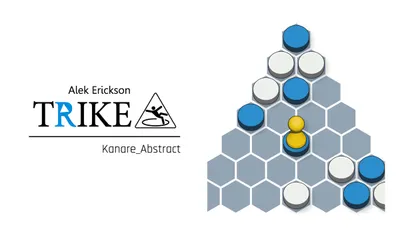
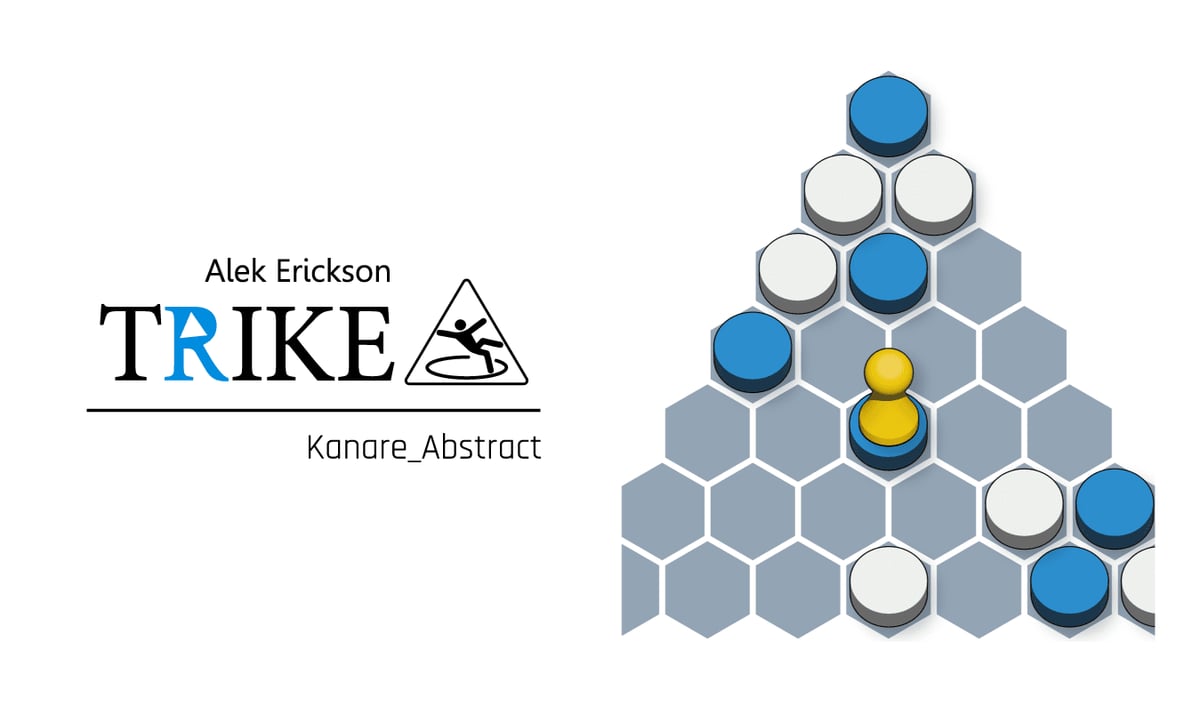
Trike is a combinatorial abstract strategy game for two players. The game revolves around setting traps, dismantling opponent traps, and maneuvering a shared piece into your own trap to win. Trike has high clarity due to the simple movement protocol, singular win condition, low branching factor, and easy-to-read board state. However, Trike is dramatic because it offers players many chances to make fatal errors. Rules: Play on an equilateral triangular hexagon-tessellated grid. Use a neutral pawn and black/white checkers. Players take turns moving a neutral pawn around on the board (passing is not allowed). The neutral pawn can move any number of empty points, in any direction in a straight line, but cannot move onto, or jump over occupied points. When a player moves the pawn, first they place a checker of their own color, onto the destination point. Then they move the pawn on top of it. When the pawn is trapped, the game is over. At the end of the game, each player gets a point for each checker of their own color adjacent to, or underneath, the pawn. The person with the highest score wins. Implement pie rule. This means, at the beginning of the game, the first player chooses a color and puts a checker on any point of the board, with the pawn on top of it. At this time only, the second player has a one-time chance to swap sides instead of making a regular move. Trike is partisan, draw-less, finite, cycle-free, always decisive, scalable with board size, and balanced with the pie rule. One note on gameplay: the score will always include one point for the last move, and one point for the second-to-last move. Therefore, who plays last has no bearing on who wins the game. The game can be played on boards with side length 7 up to 19. However, the smaller sizes (7-10) are meant for those just learning, while sizes 13-15 are standard for serious competitive play. -description from the publisher
Watch first
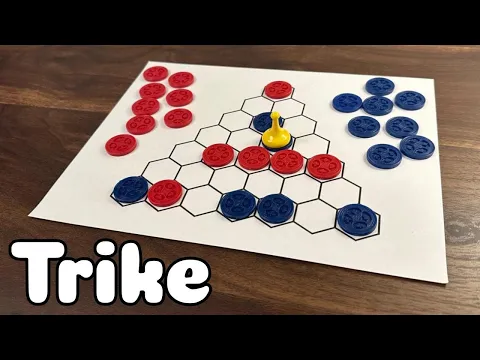
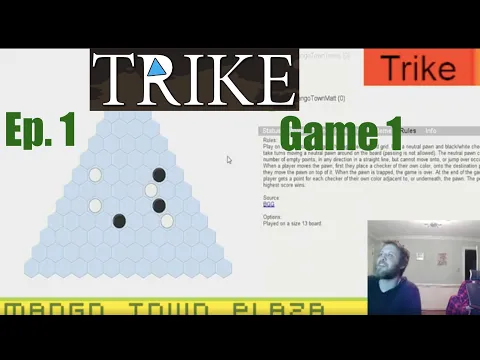
Which Trike video should I watch?
Trike has 3 videos from 3 creators: 1 how-to-play guide and 2 playthroughs. They date from 2022 to May 2024.
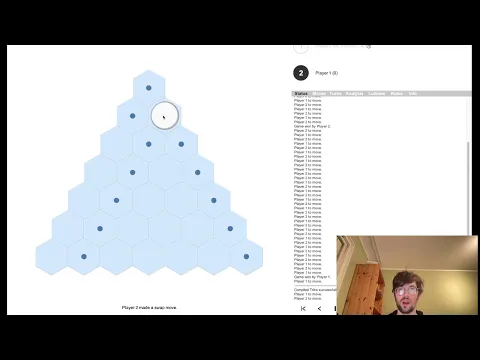
To learn the rules, start with "Trike | a free abstract game by Alek Erickson" by Riffle Shuffle & Roll, which runs 7 min.
To see it played, watch "Trike - Board Games Ep. 832" by Mango Town Plays, one of 2 playthroughs.
If you like it, try Resolve, also by Alek Erickson, or Bestiary of Sigillum: Collector's Edition, Ragnarocks and March of the Ants: Evolved Edition, which share several of its mechanics.
All videos
Creators who cover this

Alek Erickson
1 video of this game

Mango Town Plays
1 video of this game

Riffle Shuffle & Roll
1 video of this game
Games like this
2023Peter Vibe
- Videos
- 28
- Creators
- 19
Mainly reviews
1 - 4 players30 minMedium weight


2025Tim Eisner, Ryan Swisher
- Videos
- 21
- Creators
- 16
Mainly reviews
1 - 5 players60 - 90 minHeavy weight
About Trike
From BoardGameGeek:
Trike is a combinatorial abstract strategy game for two players. The game revolves around setting traps, dismantling opponent traps, and maneuvering a shared piece into your own trap to win. Trike has high clarity due to the simple movement protocol, singular win condition, low branching factor, and easy-to-read board state. However, Trike is dramatic because it offers players many chances to make fatal errors. Rules: Play on an equilateral triangular hexagon-tessellated grid. Use a neutral pawn and black/white checkers. Players take turns moving a neutral pawn around on the board (passing is not allowed). The neutral pawn can move any number of empty points, in any direction in a straight line, but cannot move onto, or jump over occupied points. When a player moves the pawn, first they place a checker of their own color, onto the destination point. Then they move the pawn on top of it. When the pawn is trapped, the game is over. At the end of the game, each player gets a point for each checker of their own color adjacent to, or underneath, the pawn. The person with the highest score wins. Implement pie rule. This means, at the beginning of the game, the first player chooses a color and puts a checker on any point of the board, with the pawn on top of it. At this time only, the second player has a one-time chance to swap sides instead of making a regular move. Trike is partisan, draw-less, finite, cycle-free, always decisive, scalable with board size, and balanced with the pie rule. One note on gameplay: the score will always include one point for the last move, and one point for the second-to-last move. Therefore, who plays last has no bearing on who wins the game. The game can be played on boards with side length 7 up to 19. However, the smaller sizes (7-10) are meant for those just learning, while sizes 13-15 are standard for serious competitive play. -description from the publisher
Designer
Alek Erickson
Artist
Kanare Kato
Publisher
Kanare_Abstract
Categories
Mechanics