Resolve
2020Alek Erickson
2 players
2 - 200 min
From BoardGameGeek
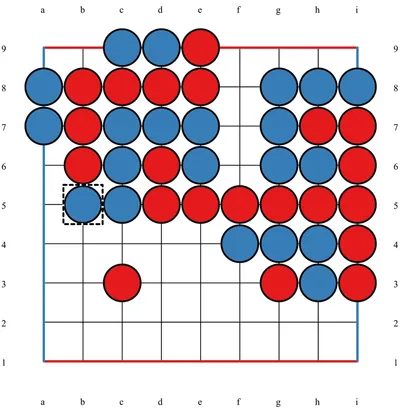
Resolve is a connection game for two players, Black and White, with sufficient black and white stones. Starting with Black, players take turns placing and swapping stones on the intersecting points of a square grid (with side lengths of either 5, 9, 13, or 19) which is initially empty. Passing is forbidden. Same-colored stones with orthogonal adjacency are connected. The game is over when a player wins by connecting their designated sides of the board with a single group of connected stones of their color, at any time during their turn or their opponent's turn. Cutting stones are four stones in the following generic crosscut configuration: OX XO On your turn, place a stone of your color on an empty point, if possible. If that created a crosscut, swap the placed stone with different adjacent enemy stones that share a crosscut with it, until that stone is no longer part of a crosscut. If you haven't placed a stone this turn, then instead choose a friendly stone in a crosscut and resolve as above. -description from the designer
Watch first

Which Resolve video should I watch?
Resolve has 2 videos from 2 creators: 1 review and 1 how-to-play guide. They date from 2024 to August 2025.
To learn the rules, start with "How to play the game of Resolve" by Alek Erickson, which runs 3 min.
For an opinion before you buy, start with "What’s New to BGA – Resolve" by Digital Board Gamer.
If you like it, try Trike, also by Alek Erickson, or Tak, Pacific Rails Inc. and Food Chain Island, which share several of its mechanics.
All videos
Creators who cover this

Alek Erickson
1 video of this game

Digital Board Gamer
1 video of this game
Games like this
2017James Ernest, Patrick Rothfuss
- Videos
- 205
- Creators
- 22
Mostly playthroughs
2 players20 - 60 minMedium weight
2020Dean Morris
- Videos
- 21
- Creators
- 19
Mainly how-to-play and unboxings
2 - 4 players60 - 90 minHeavy weight
2020Scott Almes
- Videos
- 24
- Creators
- 22
Mostly how-to-play and reviews
1 players15 minLight weight
About Resolve
From BoardGameGeek:
Resolve is a connection game for two players, Black and White, with sufficient black and white stones. Starting with Black, players take turns placing and swapping stones on the intersecting points of a square grid (with side lengths of either 5, 9, 13, or 19) which is initially empty. Passing is forbidden. Same-colored stones with orthogonal adjacency are connected. The game is over when a player wins by connecting their designated sides of the board with a single group of connected stones of their color, at any time during their turn or their opponent's turn. Cutting stones are four stones in the following generic crosscut configuration: OX XO On your turn, place a stone of your color on an empty point, if possible. If that created a crosscut, swap the placed stone with different adjacent enemy stones that share a crosscut with it, until that stone is no longer part of a crosscut. If you haven't placed a stone this turn, then instead choose a friendly stone in a crosscut and resolve as above. -description from the designer
Designer
Alek Erickson
Publisher
Self-published
Categories
Mechanics
Network and Route BuildingGrid Movement