
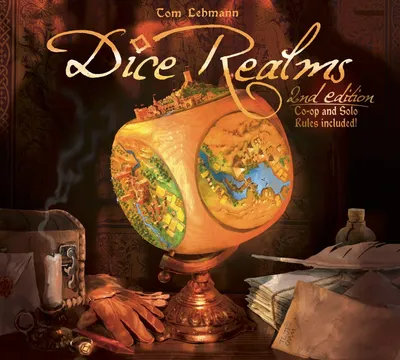
Dice Realms
2022Thomas Lehmann
- Videos
- 35
- Creators
- 29
Mainly reviews. Dice Realms is covered on BoardGameVideo.com by 16 reviews, 2 how-to-play guides, 8 recorded sessions, 5 unboxings, and 4 other videos.
1 - 4 players
45 - 60 min
Medium weight: Teach it in one sitting
From BoardGameGeek
In Dice Realms, players vie to improve and expand their Medieval realms, while contending with Fate. Realms are represented by customizable dice with faces that can be popped out and upgraded for better ones. Each game is different as during setup, players draw five tiles (from a bag of 35) to determine which extra die faces will be available beyond the five standard lines of faces: lands (victory points), farming (grain), commerce (coins), settlements (defense), and progress (upgrades). Each player begins with two identical dice and can gain more dice during play, in addition to upgrading their starting dice. Play is mostly simultaneous. To begin, players roll their dice, with one player rolling the Fate die, which affects all players. If Winter appears on the Fate die, players must pay 1 grain for each die they own or take a -2 point "misery" chip for each grain they lack. Players may then re-roll one die for free and use any re-roll or "set-a-die" tokens (that allow you to choose the die face result) that they have previously invested in for further control. Players then resolve any attacks showing, starting with the Fate die and then clockwise, with each player's attack affecting all their rivals. Each shield showing on your dice lets you ignore one attack. Successful attacks can cost players grain, the use of a die for a turn, or even the loss of a die face (which can be later rebuilt). Players collect any victory points (VPs), grain, and coins shown on their die faces. Coins are used to acquire upgrades, purchase re-roll and set-a-die tokens, repair destroyed die faces, or buy a new die -- which also costs 2 grain -- expanding their realm. At most 1 coin can be saved in your treasury from round to round. Upgrades are the heart of the game. Players receive upgrades from upgrade symbols showing or by spending coins. Die faces have 1, 2, or 4 dots on them. To change from a 1 to a 4 in the same color - such as from a yellow face collecting 2 grain to the 4-dot version that collects 4 grain and 2 coins - costs three upgrades, whereas changing from one face to a different color face at the same level costs just one upgrade. Using upgrades, crossgrades, and the "free reroll" each turn, players can craft their dice to specialize them and dramatically "tilt" the probability that a desired face is rolled. Of course, players will want different things at different times: upgrades to get going; coins to expand their realms; food if a string of harsh winters are rolled; defense against that pesky Robber on the Fate die; VP chips to race for victory; or whatever die face is the key to winning a particular setup. If during a round any player needs to use a 10 VP token, a -10 misery token, or a 10 grain token (because all of the smaller value tokens have been used), then the game ends after finishing that round; otherwise, the player with the Fate die passes it clockwise to the next player and a new round begins. When the game ends, players tally their points earned, both from VP chips and improved die faces, with 2-dot faces being worth 1 VP and 4-dot faces being worth 2 VP. Whoever has the most VPs wins.
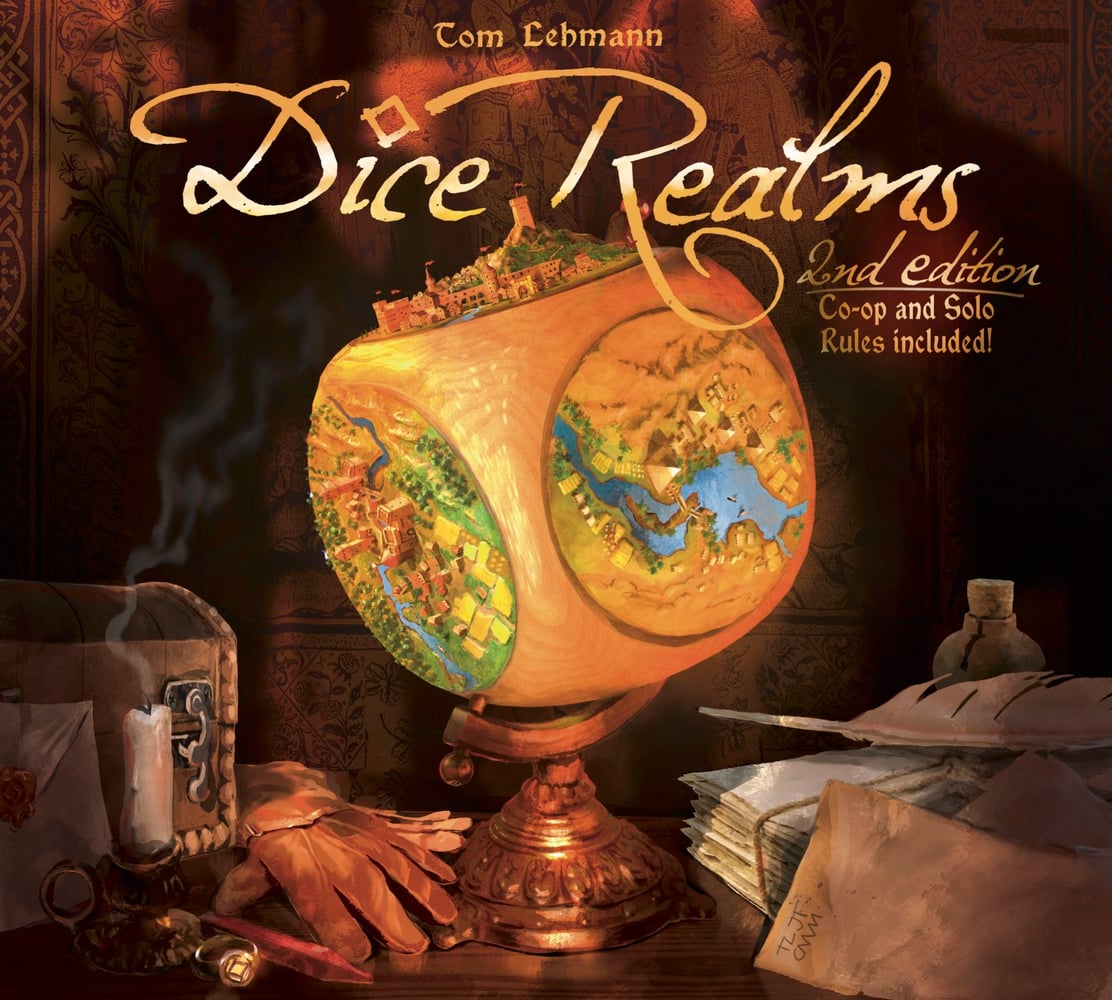
Watch first






Which Dice Realms video should I watch?
Dice Realms has 35 videos from 29 creators: 16 reviews, 2 how-to-play guides, 8 playthroughs, 5 unboxings and 4 other videos. They date from 2019 to July 2026.
To learn the rules, start with "Dice Realms - Learn While Playing!" by Getting Games, which runs 1 h 16 min. For a quicker teach, "Dice Realms Board Game | Solo Playthrough & Tutorial (With NEW Trade Expansion)" by Board Game Cabin runs 38 min.
For an opinion before you buy, start with "The 4 Squares Review - Dice Realms" by The Dice Tower. 13 creators have reviewed it. To see it played, watch "Dice Realms - GameNight! Se10 Ep23 - How to Play and Playthrough" by BoardGameGeek, one of 8 playthroughs.
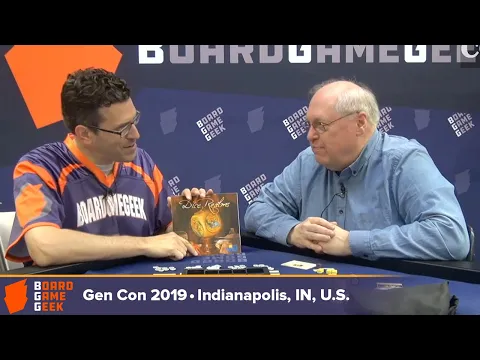
If you like it, try Res Arcana, Race for the Galaxy, New Frontiers and Jump Drive, also by Thomas Lehmann. It appears in convention videos from Gen Con 2019.
All videos





































8 of 29
Creators who cover this

Dad's Gaming Addiction
2 videos of this game

Heavy Cardboard
2 videos of this game

MrFinkreg
2 videos of this game

Rahdo Runs Through
2 videos of this game

Rolling With Two
2 videos of this game

Two Sheep One Wheat
2 videos of this game

Agent Solo Runthroughs
1 video of this game

Board Game Cabin
1 video of this game
Games like this
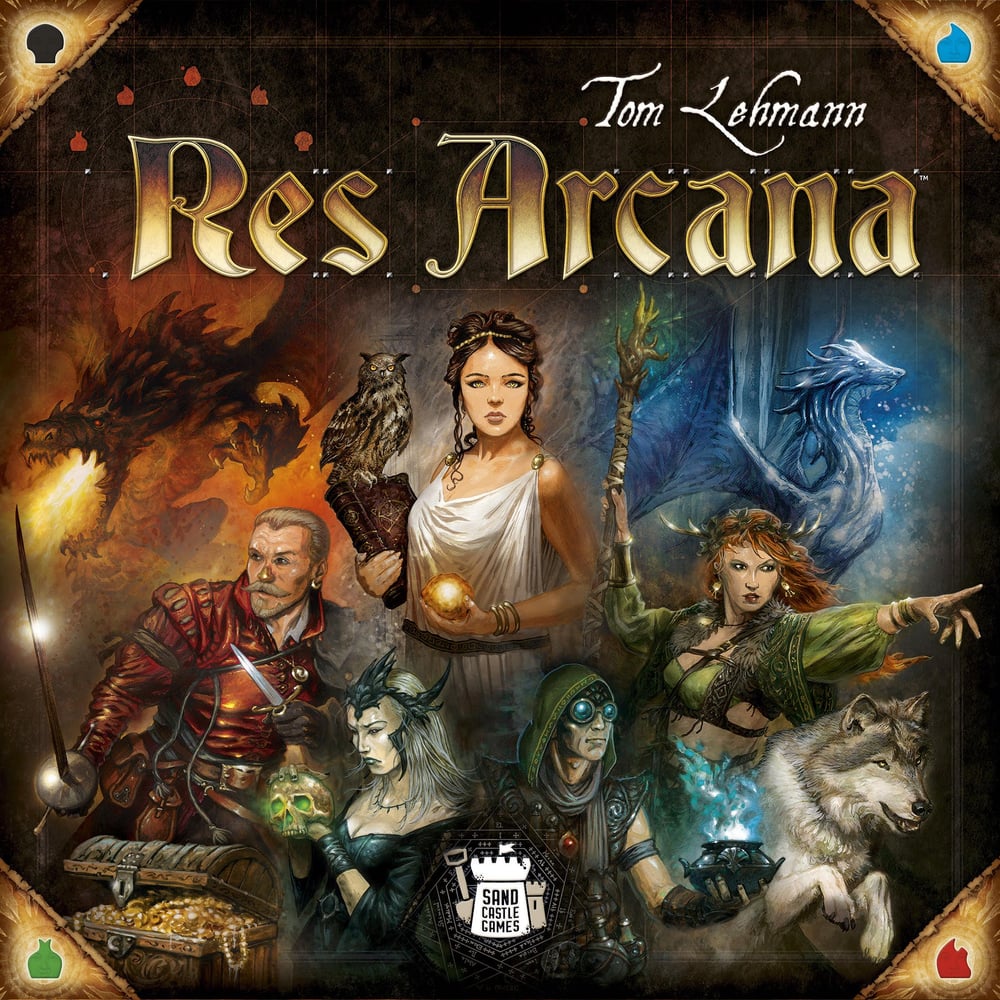

2007Thomas Lehmann
- Videos
- 64
- Creators
- 51
Mostly reviews and how-to-play
2 - 4 players30 - 60 minHeavy weight


About Dice Realms
From BoardGameGeek:
In Dice Realms, players vie to improve and expand their Medieval realms, while contending with Fate. Realms are represented by customizable dice with faces that can be popped out and upgraded for better ones. Each game is different as during setup, players draw five tiles (from a bag of 35) to determine which extra die faces will be available beyond the five standard lines of faces: lands (victory points), farming (grain), commerce (coins), settlements (defense), and progress (upgrades). Each player begins with two identical dice and can gain more dice during play, in addition to upgrading their starting dice. Play is mostly simultaneous. To begin, players roll their dice, with one player rolling the Fate die, which affects all players. If Winter appears on the Fate die, players must pay 1 grain for each die they own or take a -2 point "misery" chip for each grain they lack. Players may then re-roll one die for free and use any re-roll or "set-a-die" tokens (that allow you to choose the die face result) that they have previously invested in for further control. Players then resolve any attacks showing, starting with the Fate die and then clockwise, with each player's attack affecting all their rivals. Each shield showing on your dice lets you ignore one attack. Successful attacks can cost players grain, the use of a die for a turn, or even the loss of a die face (which can be later rebuilt). Players collect any victory points (VPs), grain, and coins shown on their die faces. Coins are used to acquire upgrades, purchase re-roll and set-a-die tokens, repair destroyed die faces, or buy a new die -- which also costs 2 grain -- expanding their realm. At most 1 coin can be saved in your treasury from round to round. Upgrades are the heart of the game. Players receive upgrades from upgrade symbols showing or by spending coins. Die faces have 1, 2, or 4 dots on them. To change from a 1 to a 4 in the same color - such as from a yellow face collecting 2 grain to the 4-dot version that collects 4 grain and 2 coins - costs three upgrades, whereas changing from one face to a different color face at the same level costs just one upgrade. Using upgrades, crossgrades, and the "free reroll" each turn, players can craft their dice to specialize them and dramatically "tilt" the probability that a desired face is rolled. Of course, players will want different things at different times: upgrades to get going; coins to expand their realms; food if a string of harsh winters are rolled; defense against that pesky Robber on the Fate die; VP chips to race for victory; or whatever die face is the key to winning a particular setup. If during a round any player needs to use a 10 VP token, a -10 misery token, or a 10 grain token (because all of the smaller value tokens have been used), then the game ends after finishing that round; otherwise, the player with the Fate die passes it clockwise to the next player and a new round begins. When the game ends, players tally their points earned, both from VP chips and improved die faces, with 2-dot faces being worth 1 VP and 4-dot faces being worth 2 VP. Whoever has the most VPs wins.
Designer
Thomas Lehmann
Artists
Martin Hoffmann, Claus Stephan
Publisher
Rio Grande Games
Categories
DiceMedieval
Mechanics