

2019John Poniske
- Videos
- 22
- Creators
- 2
Mainly reviews and how-to-play
1 - 2 players45 - 360 minHeavy weight
2023John Poniske
From BoardGameGeek
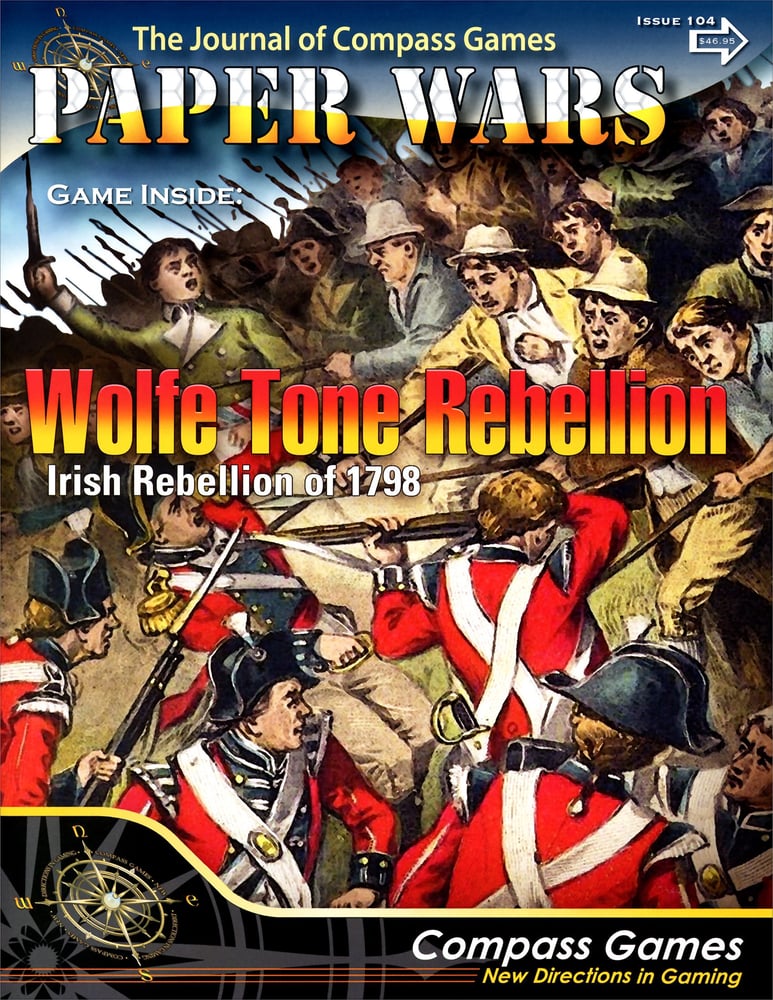
In 1796 the charismatic Irish rebel, Wolfe Tone, convinced the Revolutionary government of France and one of its finest generals, Lazare Hoche, that Ireland was poised for rebellion. Ireland would rise, he insisted, if France would only lend its support. That year, a force of 14,000 Frenchmen on 43 ships evaded the British fleet and sailed into Bantry Bay, Cork County, Ireland where rough weather forced them to abandon their operation and return to France. Two years and three audiences with Napoleon later, Tone tried again. Three waves of French landings were planned to coordinate with a general rising of the United Irishmen (Protestant and Catholic alike) all across the island. Unfortunately, word leaked and key leaders were arrested in Dublin, triggering an early rising, quickly and brutally put down by a combination of professional troops, recently raised fencibles, local militia and orange order yeomen. The rebellion staggered on through September but only in County Wexford and later in County Mayo with minimal French support, did the rebellion meet with any success. As for the French, the first wave of 1100 men under the able command of Jean Humbert, stormed ashore in County Mayo in August, 1798. A smaller force landed in Donegal in September under the command of Napper Tandy. Humbert enjoyed a few successes but soon surrendered to the overwhelming force Lord Cornwallis brought to bear. Soon after, Tandy abandoned the Emerald Isle when he realized he could no longer be of service to Humbert. A month later and further North off the coast of Donegal, a second wave of 3000 men under Jean Hardy and Wolfe Tone himself met with disaster. Hardy's fleet ran afoul of the British fleet and Tone was captured. Imprisoned and condemned to hang, Tone committed suicide. The third and largest wave of French soldiers never sailed. Without determined French support the Irish rebellion of 1798 stood little chance of success. Historically it was a bloody great uncoordinated fiasco made worse by the early demise of Tone's benefactor, General Hoche to consumption. History might have been different if the stars had aligned, if those key Irish leaders had not been captured and their plans revealed, if the rebels had received a sizeable number of French and British arms, if Hoche had survived. If a second and even a third wave of French regulars had landed, and if those French regulars had landed while the rebellion was still vibrant, then – then, as WOLFE TONE'S RISING reveals, England would have had a serious problem. WOLFE TONE'S RISING puts the aforementioned what-ifs into play. A short game of seven turns pits English regulars and loyalist militia against the Irish rebels and their French allies. Here, the French play a shell game with the British attempting to land troops in Ireland not once but three times. Here, unknown morale plays a vital role to the outcome of every battle. Here, Local leaders are not cookie cut-outs but individuals who enjoy unique abilities in battle. And here, each battle is assisted by a battle board utilizing fresh mechanics that make each battle a mini-game unto itself. A note on the leaders used: British and French leaders are key historical leaders, whereas Irish rebel leaders are largely representational. Anonymous loyalist leaders represent a mixture of militia and yeomen. Loyalist hierarchy was either nonexistent or too confusing to identify specific names.

2019John Poniske
1 - 2 players45 - 360 minHeavy weight
2022John Poniske
1 - 4 players60 - 120 minMedium weight
2022John Poniske
2 players180 - 240 minMedium weight
2025John Poniske
1 - 2 players15 - 360 minMedium weight
From BoardGameGeek:
In 1796 the charismatic Irish rebel, Wolfe Tone, convinced the Revolutionary government of France and one of its finest generals, Lazare Hoche, that Ireland was poised for rebellion. Ireland would rise, he insisted, if France would only lend its support. That year, a force of 14,000 Frenchmen on 43 ships evaded the British fleet and sailed into Bantry Bay, Cork County, Ireland where rough weather forced them to abandon their operation and return to France. Two years and three audiences with Napoleon later, Tone tried again. Three waves of French landings were planned to coordinate with a general rising of the United Irishmen (Protestant and Catholic alike) all across the island. Unfortunately, word leaked and key leaders were arrested in Dublin, triggering an early rising, quickly and brutally put down by a combination of professional troops, recently raised fencibles, local militia and orange order yeomen. The rebellion staggered on through September but only in County Wexford and later in County Mayo with minimal French support, did the rebellion meet with any success. As for the French, the first wave of 1100 men under the able command of Jean Humbert, stormed ashore in County Mayo in August, 1798. A smaller force landed in Donegal in September under the command of Napper Tandy. Humbert enjoyed a few successes but soon surrendered to the overwhelming force Lord Cornwallis brought to bear. Soon after, Tandy abandoned the Emerald Isle when he realized he could no longer be of service to Humbert. A month later and further North off the coast of Donegal, a second wave of 3000 men under Jean Hardy and Wolfe Tone himself met with disaster. Hardy's fleet ran afoul of the British fleet and Tone was captured. Imprisoned and condemned to hang, Tone committed suicide. The third and largest wave of French soldiers never sailed. Without determined French support the Irish rebellion of 1798 stood little chance of success. Historically it was a bloody great uncoordinated fiasco made worse by the early demise of Tone's benefactor, General Hoche to consumption. History might have been different if the stars had aligned, if those key Irish leaders had not been captured and their plans revealed, if the rebels had received a sizeable number of French and British arms, if Hoche had survived. If a second and even a third wave of French regulars had landed, and if those French regulars had landed while the rebellion was still vibrant, then – then, as WOLFE TONE'S RISING reveals, England would have had a serious problem. WOLFE TONE'S RISING puts the aforementioned what-ifs into play. A short game of seven turns pits English regulars and loyalist militia against the Irish rebels and their French allies. Here, the French play a shell game with the British attempting to land troops in Ireland not once but three times. Here, unknown morale plays a vital role to the outcome of every battle. Here, Local leaders are not cookie cut-outs but individuals who enjoy unique abilities in battle. And here, each battle is assisted by a battle board utilizing fresh mechanics that make each battle a mini-game unto itself. A note on the leaders used: British and French leaders are key historical leaders, whereas Irish rebel leaders are largely representational. Anonymous loyalist leaders represent a mixture of militia and yeomen. Loyalist hierarchy was either nonexistent or too confusing to identify specific names.