Watch “Wyrmspan - Board With Each Other Review,” a board game review for Wyrmspan from Board With Each Other on BoardGameVideo.
Description provided by Board With Each Other on YouTube:
Hey you, yes, you! Thanks for joining us!
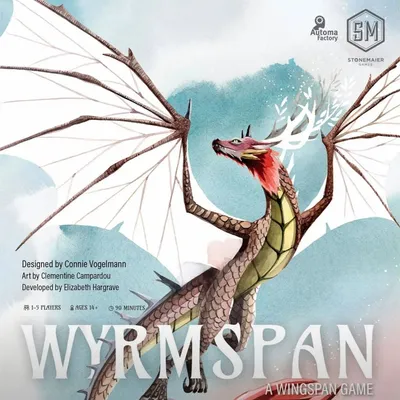
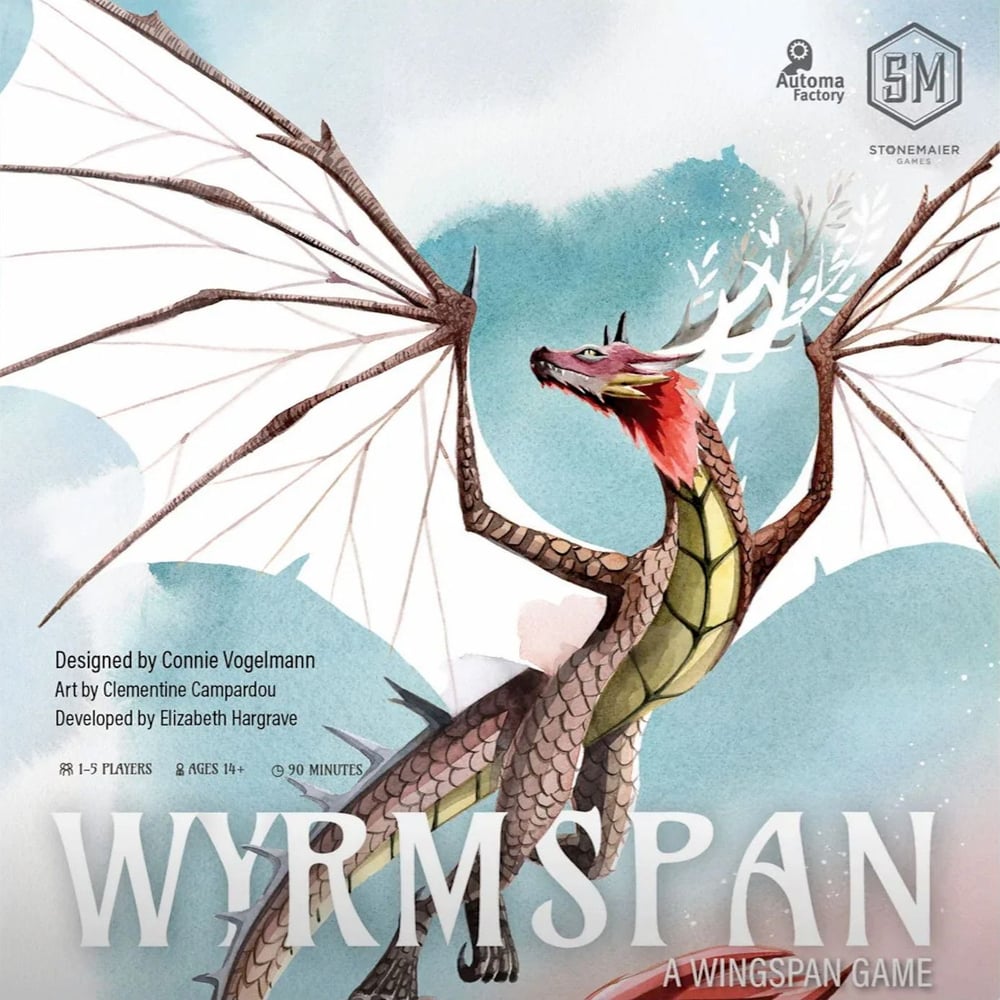
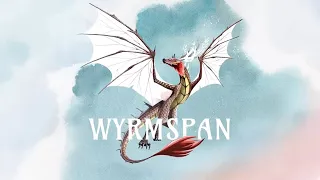
In this episode of Board With Each Other we appraise the tableau / engine builder Wyrmspan - Stonemeir's new fantasy riff on the modern classic Wingspan.
As always we appraise the game, it's components and it's fun factor and then go on to review it for how well it works as a 2 player game. Also, is milk an appropriate food for dragons?
Find us on Social Media
Facebook
Twitter
Instagram
Al: Hello everybody and welcome to Board With Each Other, the board gaming review podcast that looks at board games through the lens of playing them as a pair, whether that's with your partner, your BFFF, or with a spouse that continuously refers to herself as the mother of dragons.
Hannah: I am the mother of dragons.
Al: On that note, I'm Al Simpson. I'm joined as ever by my co host, player two, and lovely wife, Hannah Kelly.
Hannah: Hi, guys.
Al: And today in this month's episode, we are going to be reviewing the card driven engine builder that is Wyrmspan. Wyrmspan is a remix, rewrite and, renew of the world, straddling incredibly popular Wingspan. and it is not the same game. It's about 75% the same game as far as I understand it. I just want to put a caveat at the start of the episode that neither of us have actually played. Wingspan. It's never sort of grabbed me enough to pick up a copy, mainly because I'm not that interested in birds.
Hannah: Yeah, why would you go for birds when you could go for dragons?
Al: And I was sort of considering it when this came around, but I was like, oh, okay, there's a dragon one now, let's go with that. but as far as I understand it, this is the same but different. It's not sort of compatible with it. There's quite a few new mechanics, and it is slightly more complex than the original, sans expansions, obviously. I know there's a lot of expansions to Wingspan that add a lot to it, but, just sort of vanilla out of the box is supposed to be the slightly more complicated of the two.
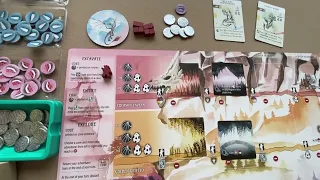
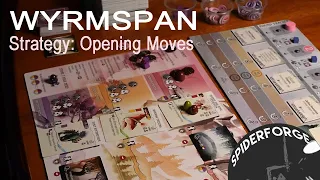
How the game works, and the premise of the game is you are the owner of three dragon caves, and within those dragon caves you need to basically excavate them and dig them out and place dragons into those caves and then take a stroll through your lovely collection of dragons who don't eat you for reasons unknown, and accumulate resources, building an engine, as it were, through sort of a tableau that you have out on your player board in front of you. How that works is games played over four rounds of multiple turns on a turn. Each player will take one action each. To take an action, you usually have to spend a coin, of which you get six every turn. There are ways to get more via cards during the game, but six is the basic start that you have every turn. And with those coins, you can take one of three actions. You can excavate your caves, which means you place a cave card down one of the open slots, the leftmost slot of all of your caves. You start off the game with the first cave excavated so you can start placing dragons immediately. But after that you need a cave placed down over an empty slot in order to place the dragon there. Those cave cards usually have instant effects, so most the time will gain you resources. Sometimes cards, sometimes it'll move you forward on the dragon Guild marker, which I'll get on to in a minute. You can entice a dragon. You don't buy dragons, you entice them and you do so by spending a coin to take the action and then paying the resources.
Hannah: It would be immoral, I think, to buy dragons.
Al: Yeah, I think it would be so you definitely have to entice them. You know, show a bit of leg or failing that some milk. You start the game with three resources of your choice. So you can start placing dragons, potentially straight away. I think off the top of my head there are five resources. Milk, meat, gold, crystal and coin and coins.
Hannah Kelly: Eggs.
Al: Yeah, eggs as well. So each dragon will have a listed cost on it. You pay the resources, you place the dragon card down. Some dragon cards will have an immediate effect. Some dragon cards will have an effect that occurs at the end of every round. Others will have an endgame effect, and others will have an effect when you walk past them. When you go exploring, which is your third action to explore, you place a coin down on the cave that you want to explore and you basically walk along a track that is made half by the player board but also half by the dragon cards that you put down. And depending on which row you go for, the top one is resource focused. The middle one is dragon card focused. The bottom one is cave card focused. You will collect those as you go. And any special abilities you've had on your dragons that you place down. Play continues until both players either run out of coins or pass. When that occurs, each round has a randomly, generated scorecard associated with it and one specific criteria.