Loteria

Loteria

1887(Uncredited)

2 - 10 players
10 min
1.1/5 weight

From BoardGameGeek

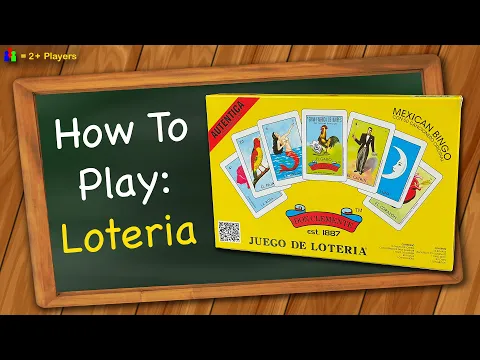
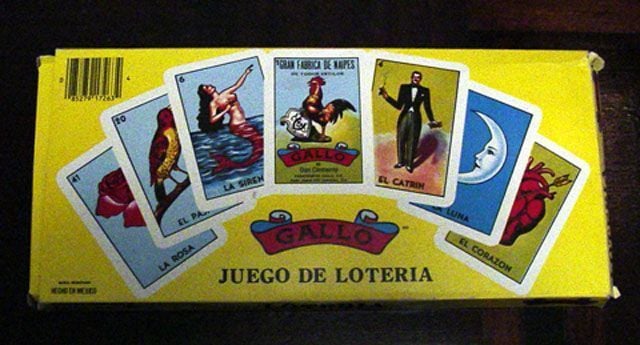
Loteria is a traditional Mexican game combining cards and Bingo, and it has been played as a game of chance, as a pastime and for educational purposes. Cards are drawn and the illustrations matched to Bingo-like grid cards, each showing 16 of the 54 possible cards. Like Bingo, one may win by matching all of the fields on the grid-card, or by matching a horizontal, vertical or diagonal line. The cards themselves are colourfully and engagingly illustrated, and the Spanish captions will be helpful to anyone studying that language. Because the Lotería cards include the name of the item beneath its illustration, they are used to teach reading, writing, history and social values. Many bilingual teachers use the game as a teaching tool in the United States. The most recognized version of Lotería is the "Don Clemente Gallo" version, introduced in Mexico in 1887 by French businessman Don Clemente Jacques. The owners of Don Clemente Gallo Pasatiempos have continued this version through three generations. Throughout the past hundred years, the original artwork found on its 54 cards has remained the same, though the company issued a special edition in 2002 featuring the paintings of artist Teresa Villegas. [For the game Lotto, go to its separate entry.] The traditional Mexican game Loteria is slightly different from Lotto, and the origin of modern Lotto, and eventually Bingo... A popular attraction at Mexican fairs and events, as many as ten participants play at a time. The artwork is typically beautiful and tied closely to the cultural mythology and traditions of Mexican culture. This is the biggest departure which modern Lotto and Bingo have made from the traditional "Loteria". It can be played with as few as three persons: one who "sings" the lottery verses and the remainder who place a chip or a dried bean on its "tabla" every time that one of the figures pictured on the cards is mentioned. Example: The number 7 card entitled, El Luchador (the wrestler), and name is announced, and the song which is sung when it is drawn is, "Blue Demon es mi favorito!" (The wrestler, Blue Demon is my favorite one!) The cards are formatted differently, as they utilize four columns of four numbered figures, chosen randomly from a lot of 54 possible different items--each with its own name and song. Common variations of play, due to the 4X4 grid are: Tabla Completa = filling the complete grid. Linea Horizontal, Vertical, o Diagonal = the same as in English. Forma de Letra = where participants form the capital letter "A", "Z", "C", "L" or "O" on the board. As in lottery or bingo, the participant who completes the agreed upon "tabla" requirement wins, and must shout "LOTERIA!"

Watch first

Creators who cover this

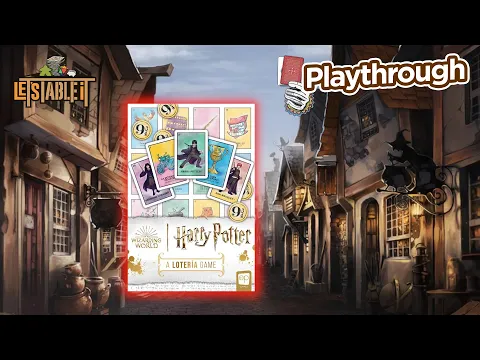
Let's Table It
Let's Table It
1 video of this game
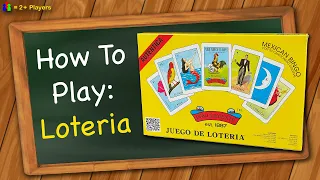
Triple S Games
Triple S Games
1 video of this game

Games like this

1876(Uncredited)

Videos
82
Creators
58
Mostly reviews and how-to-play

2 - 4 players30 min1.2 weight
1475(Uncredited)

Videos
76
Creators
53
Mainly playthroughs and how-to-play

2 players0 min3.6 weight

400(Uncredited)

Videos
42
Creators
23
Mostly how-to-play and playthroughs

2 players20 min2.5 weight

-2200(Uncredited)

Videos
40
Creators
4
Mainly how-to-play

2 players30 - 180 min3.9 weight

About Loteria

From BoardGameGeek:

Loteria is a traditional Mexican game combining cards and Bingo, and it has been played as a game of chance, as a pastime and for educational purposes. Cards are drawn and the illustrations matched to Bingo-like grid cards, each showing 16 of the 54 possible cards. Like Bingo, one may win by matching all of the fields on the grid-card, or by matching a horizontal, vertical or diagonal line. The cards themselves are colourfully and engagingly illustrated, and the Spanish captions will be helpful to anyone studying that language. Because the Lotería cards include the name of the item beneath its illustration, they are used to teach reading, writing, history and social values. Many bilingual teachers use the game as a teaching tool in the United States. The most recognized version of Lotería is the "Don Clemente Gallo" version, introduced in Mexico in 1887 by French businessman Don Clemente Jacques. The owners of Don Clemente Gallo Pasatiempos have continued this version through three generations. Throughout the past hundred years, the original artwork found on its 54 cards has remained the same, though the company issued a special edition in 2002 featuring the paintings of artist Teresa Villegas. [For the game Lotto, go to its separate entry.] The traditional Mexican game Loteria is slightly different from Lotto, and the origin of modern Lotto, and eventually Bingo... A popular attraction at Mexican fairs and events, as many as ten participants play at a time. The artwork is typically beautiful and tied closely to the cultural mythology and traditions of Mexican culture. This is the biggest departure which modern Lotto and Bingo have made from the traditional "Loteria". It can be played with as few as three persons: one who "sings" the lottery verses and the remainder who place a chip or a dried bean on its "tabla" every time that one of the figures pictured on the cards is mentioned. Example: The number 7 card entitled, El Luchador (the wrestler), and name is announced, and the song which is sung when it is drawn is, "Blue Demon es mi favorito!" (The wrestler, Blue Demon is my favorite one!) The cards are formatted differently, as they utilize four columns of four numbered figures, chosen randomly from a lot of 54 possible different items--each with its own name and song. Common variations of play, due to the 4X4 grid are: Tabla Completa = filling the complete grid. Linea Horizontal, Vertical, o Diagonal = the same as in English. Forma de Letra = where participants form the capital letter "A", "Z", "C", "L" or "O" on the board. As in lottery or bingo, the participant who completes the agreed upon "tabla" requirement wins, and must shout "LOTERIA!"

Designer

(Uncredited)

Categories

Card Game

Mechanics

Betting and BluffingBingoModular Board
View on BoardGameGeek ›