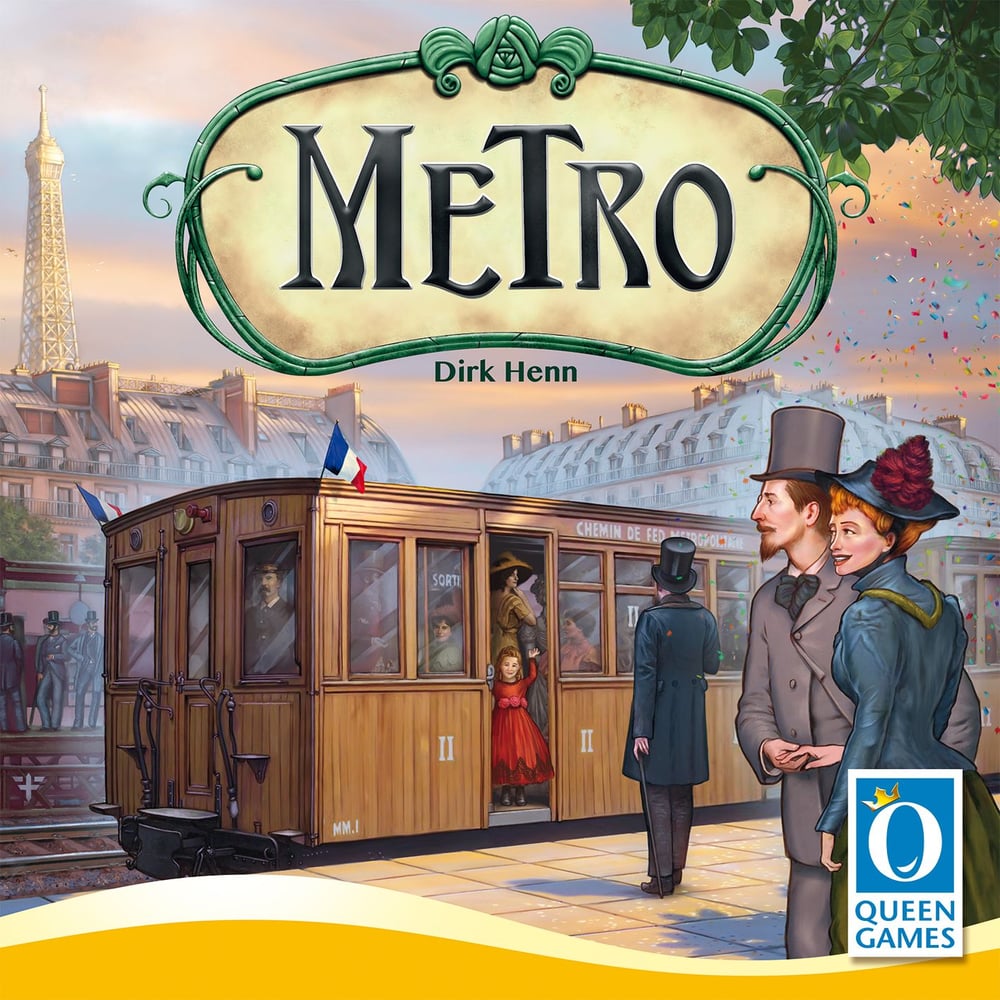
Metro
1997Dirk Henn
2 - 6 players
30 min
1.7/5 weight
From BoardGameGeek
Similar to Streetcar, Tsuro, Tantrix and Spaghetti Junction, this game has players putting square tiles onto the board to form rail lines. The major difference in this game, however, is that players are not striving to make short, direct routes like those sought in Streetcar. Instead, the object of the game is to make the rail lines as long as possible. Players start with a number of trains ringing the board. Whenever a tile placement connects a train to a station (either on the edge or the center of the board), that train is removed and the player scores one point for each tile that the route crosses, which can cause one tile to score multiple times if the track loops around. However, players score double for city connections, which are the stations in the center of the board. For those interested in graph theory, a key part of the Metro game design is that the routes will always connect a starting subway train station with an empty destination station, rather than routing to another starting subway train station. The tiles implement a design principle which allows any tile to be placed on any open grid space, subject to rules for alignment with existing tile edges. If correctly placed per the rules, the routing will allow for all trains to score, albeit not necessarily for the high run value the owner would like to attain. The game was originally issued as Iron Horse (not to be confused with Iron Horse). Re-implemented by: Cable Car
All videos
Creators who cover this

Board Gems
1 video of this game

Rabesandratana
1 video of this game
Games like this
About Metro
From BoardGameGeek:
Designer
Dirk Henn
Artists
Barbara Henn, Franz Vohwinkel
Categories
Trains
Mechanics
Network and Route BuildingTile Placement