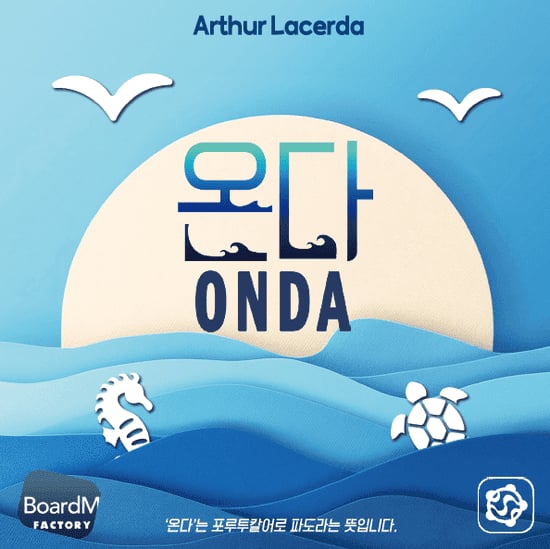
ONDA

ONDA

2024Arthur Lacerda

2 - 5 players
30 - 40 min
1.8/5 weight

From BoardGameGeek

In ONDA, players use cards from their hands to compose wave formations superior to those of their opponents according to the current tide. Your goal is to be the first to play all your cards; failing that, try to have as few cards as possible since you lose points based on what's left in your hand. In more detail, at the start of play the tide is coming in, that is, high numbers are better than low. In each round, each player starts with a hand of cards, placing two cards face down in front of them; these cards are now wild and still considered part of their hand. To start the trick, the lead player plays a formation consisting of a single card, 2-4 cards of the same value, or a sequence of 2-4 cards. Subsequent players can (1) play a better formation - "better" being determined by the tide - (2) pass and be out of the trick, (3) turn the tide by returning one of their face-down cards to their hand, flipping the tide card (so now low numbers are better than high, or vice versa), then playing a better combination, or (4) play a bomb. Six types of bombs exist in ONDA, and the current bomb type is shown on top of the bomb deck. A bomb, e.g., a two-card sequence in the same suit, supersedes the current formation, and once played players must beat this formation instead of the previous one. At most one bomb can be played in a trick, and only one player can turn the tide. Once all but one player have passed in a trick, clear all played cards and move the top bomb card to the bottom of that deck. Whoever last played leads a new formation. Once a player has no cards in hand - regardless of face-down cards on the table - the round ends, and everyone but that player loses points based on their unplayed cards. After four rounds, whoever has the most points wins.

There are no videos for this game yet.

Creators who cover this

Taylor's Trick-Taking Table
1 video of this game

Games like this
2025Arthur Lacerda

Videos
2
Creators
2
How-to-play

2 - 3 players15 min

2025Arthur Lacerda

Videos
1
Creators
1
How-to-play

3 - 5 players20 - 30 min3.0 weight

2025Arthur Lacerda

Videos
1
Creators
1
How-to-play

1 - 2 players5 - 10 min1.0 weight

2019Kei Kajino (梶野 桂)

Videos
87
Creators
77
Mainly reviews

2 - 5 players20 min1.4 weight

About ONDA

From BoardGameGeek:

In ONDA, players use cards from their hands to compose wave formations superior to those of their opponents according to the current tide. Your goal is to be the first to play all your cards; failing that, try to have as few cards as possible since you lose points based on what's left in your hand. In more detail, at the start of play the tide is coming in, that is, high numbers are better than low. In each round, each player starts with a hand of cards, placing two cards face down in front of them; these cards are now wild and still considered part of their hand. To start the trick, the lead player plays a formation consisting of a single card, 2-4 cards of the same value, or a sequence of 2-4 cards. Subsequent players can (1) play a better formation - "better" being determined by the tide - (2) pass and be out of the trick, (3) turn the tide by returning one of their face-down cards to their hand, flipping the tide card (so now low numbers are better than high, or vice versa), then playing a better combination, or (4) play a bomb. Six types of bombs exist in ONDA, and the current bomb type is shown on top of the bomb deck. A bomb, e.g., a two-card sequence in the same suit, supersedes the current formation, and once played players must beat this formation instead of the previous one. At most one bomb can be played in a trick, and only one player can turn the tide. Once all but one player have passed in a trick, clear all played cards and move the top bomb card to the bottom of that deck. Whoever last played leads a new formation. Once a player has no cards in hand - regardless of face-down cards on the table - the round ends, and everyone but that player loses points based on their unplayed cards. After four rounds, whoever has the most points wins.

Designer

Arthur Lacerda

Artist

Arthur Lacerda

Categories

Card Game

Mechanics

Hand ManagementLadder Climbing
View on BoardGameGeek ›