


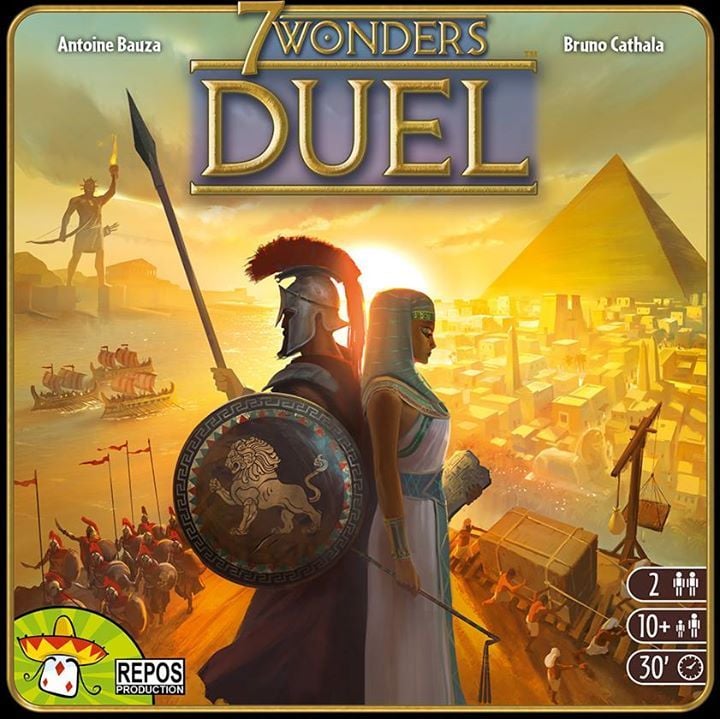
2015Antoine Bauza, Bruno Cathala
- Videos
- 224
- Creators
- 73
Some reviews
2 players30 min2.2 weight
2007Bruno Cathala
From BoardGameGeek
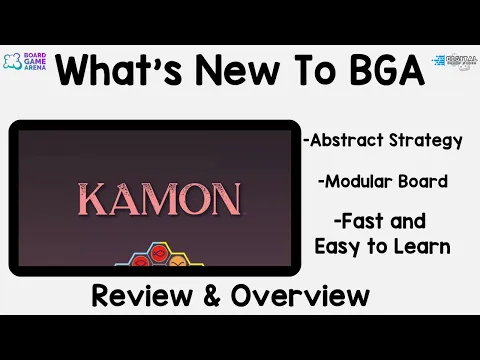
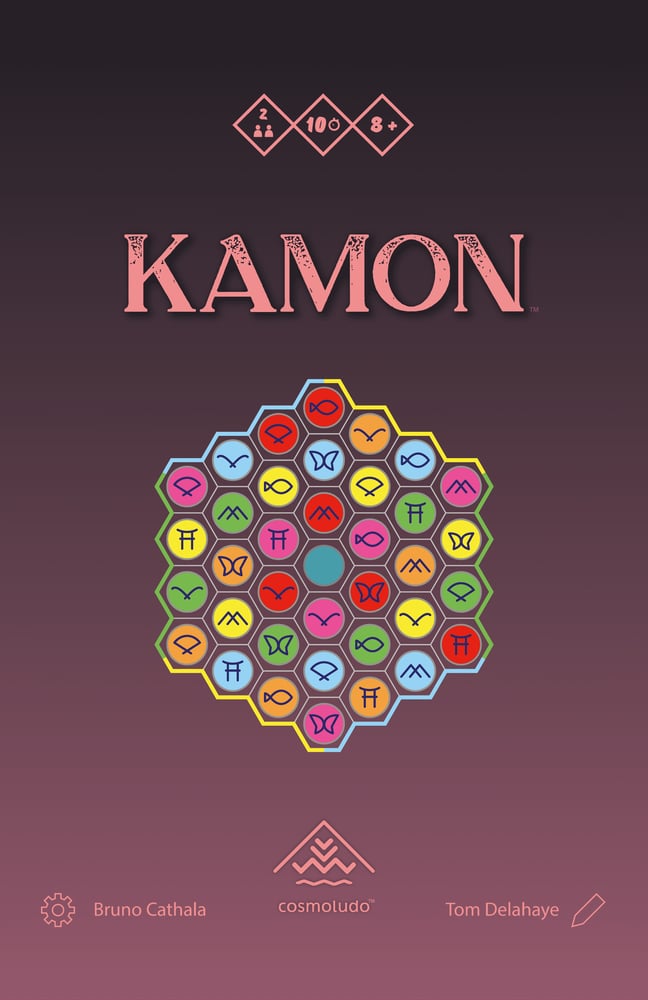
To set up the two-player abstract strategy game Kamon, shuffle the game's 37 tokens and fill the hexagonal grid with one token on each hex. The tokens consist of one blank token and 36 tokens in six colors and six symbols, with each combination appearing once. (In earlier versions of the game, tokens were valued 1-6 in each of six different symbols, with one hex being left empty.) The blank token fills space and serves only as a barrier. To start, the black player places one of their pawns on a perimeter space that touches only one side of the hex. The token on this space, e.g. the red fish, indicates where the white player must place one of their pawns on the next turn, either on a red token or on a fish token, and the white player's pawn constrains where the black player can next place a pawn. Players continue taking turns in this manner, and the game ends immediately when one of three victory conditions are fulfilled: A player connects two opposite edges of the grid with their pawns (as in Hex). A player surrounds one or more hexes with a loop of their pawns without regard as to whether those hexes are empty or occupied by the opponent's pawns. A player prevents their opponent from placing a pawn, e.g. by occupying the yellow mountain when no more yellow tokens or mountain tokens are available.


2015Antoine Bauza, Bruno Cathala
2 players30 min2.2 weight
2024Antoine Bauza, Bruno Cathala
2 players30 min2.1 weight
2022Marc André, Bruno Cathala
2 players30 min2.0 weight
2022Bruno Cathala, Théo Rivière
2 - 4 players30 - 45 min1.5 weight
From BoardGameGeek:
Designer
Bruno Cathala
Artist
Tom Delahaye
Categories
Mechanics