
2015Antoine Bauza, Bruno Cathala
- Videos
- 222
- Creators
- 71
Some reviews
2 players30 minMedium weight

2012Bruno Cathala
From BoardGameGeek
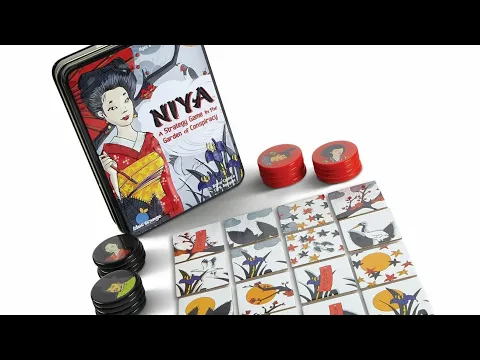
In Okiya, a.k.a. Niya,, each player tries to arrange their tokens to gain the favor of the emperor. Alternatively, you can prevent your rival from placing a token in the Imperial garden, showing that you have more control than your opponent. To set up the game, shuffle the 16 tiles and arrange them in a 4x4 square; each tile shows one of four types of vegetation (maple, cherry, pine or iris) and one of four types of poetic symbols (rising sun, bird, rain or tanzaku - the small pieces of paper on which people sometimes write wishes). The starting player removes one tile on the border of the square, sets this tile aside, then places one of their tokens in this space. The opponent must then do the same thing, but can choose from only those tiles that depict the same type of vegetation or poetic symbol shown on the tile first set aside. Play continues, with each set-aside tile determining where the next player can go until: A player forms a line with four of their tokens in any direction, A player forms a 2x2 square with four of their tokens, or A player chooses a tile which doesn't allow their opponent to place a token. In any of these cases, the player has won the game. (Exception: if a player removes the last tile, the game ends in a tie.) A match can be a single game, a "best of three" series, or a point-based match, with the winner of a game earning as many points as the number of tiles remaining in the grid when they win; in this case, the player who first collects ten points wins the match.

2015Antoine Bauza, Bruno Cathala
2 players30 minMedium weight
2024Antoine Bauza, Bruno Cathala
2 players30 minMedium weight
2022Marc André, Bruno Cathala
2 players30 minMedium weight
2022Bruno Cathala, Théo Rivière
2 - 4 players30 - 45 minLight weight
From BoardGameGeek:
In Okiya, a.k.a. Niya,, each player tries to arrange their tokens to gain the favor of the emperor. Alternatively, you can prevent your rival from placing a token in the Imperial garden, showing that you have more control than your opponent. To set up the game, shuffle the 16 tiles and arrange them in a 4x4 square; each tile shows one of four types of vegetation (maple, cherry, pine or iris) and one of four types of poetic symbols (rising sun, bird, rain or tanzaku - the small pieces of paper on which people sometimes write wishes). The starting player removes one tile on the border of the square, sets this tile aside, then places one of their tokens in this space. The opponent must then do the same thing, but can choose from only those tiles that depict the same type of vegetation or poetic symbol shown on the tile first set aside. Play continues, with each set-aside tile determining where the next player can go until: A player forms a line with four of their tokens in any direction, A player forms a 2x2 square with four of their tokens, or A player chooses a tile which doesn't allow their opponent to place a token. In any of these cases, the player has won the game. (Exception: if a player removes the last tile, the game ends in a tie.) A match can be a single game, a "best of three" series, or a point-based match, with the winner of a game earning as many points as the number of tiles remaining in the grid when they win; in this case, the player who first collects ten points wins the match.
Designer
Bruno Cathala
Artist
Cyril Bouquet
Publisher
Blue Orange (EU)
Categories
Mechanics