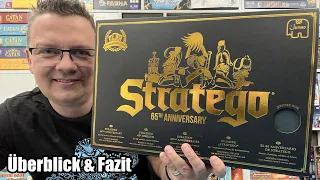
Watch “Kilroy’s Deep Dive Into Stratego,” a board game review for Stratego from KilroyWasHere on BoardGameVideo.
Description provided by KilroyWasHere on YouTube:
Before 1900
Chinese strategy games — early cousins
While not direct ancestors in the documentary sense, several Chinese board games share striking structural similarities with Stratego, including Dou Shou Qi (Jungle / Game of Fighting Animals), where two-player game with animals of different strengths capturing weaker ones. Includes lakes and terrain features similar to Stratego’s board layout. Pieces are open information (not hidden), but the rank-based capture mechanism is similar.
~1895 — Gunjin Shōgi (Japanese Military Chess)
A two-player hidden-information war game was sold and played in Japan by the late 19th century; players kept piece identities face-down and aimed to capture the opponent’s flag. This game was reported in Germany in 1905 and likely existed earlier. Gunjin Shōgi (Japanese Military Chess) appeared in Japan as early as the late 19th century. This was a strategic war game with upright pieces of differing ranks kept face-down so opponents couldn’t see them — an early form of hidden information. It required a referee to resolve battles because players didn’t know each other’s piece identities. The influence on L’Attaque (and indirectly Stratego) is suggested by game historians, though the precise degree of influence is debated because later commercial forms of Gunjin Shōgi incorporated World War I and II elements. This Japanese predecessor introduced the concept of hidden ranks and battlefield deduction, which is a hallmark of Stratego.
1900s — Early 20th Century Innovations
1905–1907 — Early war game developments in Europe
Articles describing Gunjin Shōgi appeared in Europe, and related war-game patents began emerging. Even before L’Attaque, early military chess variants and war simulation games existed in Europe (and North America). They often involved strategic movement of units representing armies (e.g., Strategos by Charles A. L. Totten, based on Prussian Kriegsspiel). These weren’t direct influences on Stratego, but they show that abstract battle simulations were already popular in European gaming culture before L’Attaque formalized the hidden-rank mechanic
1908–1909 — Hermance Édan patents L’Attaque
On Nov 26, 1908, French designer Hermance Édan filed a patent for jeu de bataille avec pièces mobiles sur damier (“battle game with mobile pieces on a board”). The patent was granted in 1909.
1910 — L’Attaque commercially released in France
Sold by Au Jeu Retrouvé and also appearing in Britain before WWI, L’Attaque featured hidden piece strengths, rank hierarchy, and objective to capture the opponent’s flag — a clear structural precursor to Stratego. L’Attaque is widely recognized as the most direct predecessor to Stratego. Designed by Hermance Edan, the French game patented in 1909 as jeu de bataille avec pièces mobiles sur damier (“battle game with mobile pieces on a gameboard”), and sold as L’Attaque from 1910. It featured hidden identities and a hierarchy of ranked pieces, with players trying to capture the opponent’s flag or eliminate their forces — very similar to Stratego’s core mechanics. Pieces were placed face-down and only revealed in battle, thus introducing the hidden-information gameplay that defines Stratego. Stratego later adopted many elements from L’Attaque’s structure — number order, flag objective, bombs and spies — and significantly expanded them
1910s–1930s — Evolution of War Games
1911–1930s — Variants and related war strategy games in Europe
After L’Attaque, other related war games appeared (e.g., naval and aviation variants by H.P. Gibson & Sons), reflecting popularity of hidden-information combat games prior to WWII.
1930s — Chinese Lu Zhan Qi (Land Battle Chess/Army Chess)
A Chinese hidden-information strategy game evolved from the older Dou Shou Qi (“Jungle” or “Game of Fighting Animals”), integrating rank capture and flag objectives, and sharing more structural similarity with Stratego. A later Chinese game that uses hidden piece identities and flag objectives much like Stratego. Players set up armies secretly and try to capture the enemy’s flag, very similar to Stratego’s end condition. These games likely reflect a broader tradition of rank-based capture strategy games in East Asia — a conceptual background that L’Attaque and Stratego fit into, even if not directly derived.
1940s — Birth of Modern Stratego
Before 1942 — Jacques Johan Mogendorff develops Stratego
In the Netherlands, Mogendorff designed modern Stratego, drawing strongly on L’Attaque and the broader family of war strategy games. The name Stratego was registered as a trademark in 1942 in the Netherlands.
1946 — First post-war European edition published
Stratego began commercial production after WWII and quickly spread throughout Europe.
1950s–1960s — Commercial Expansion
1958–1960 — U.S. trademark & Milton Bradley edition
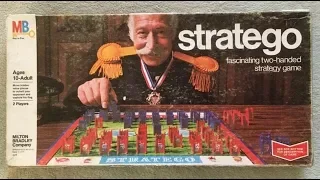
The U.S. trademark was filed in 1958 and registered in 1960; Milton Bradley introduced Stratego to the U.S. market in 1961.
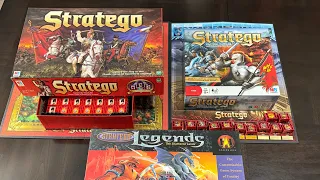



















 0:31

 0:31
 0:30



 3:57