Watch “Is this 1/72 scale Medieval Castle usable for 28mm wargaming? Lets find out!,” a board game review on BoardGameVideo.
Description provided by Potan's War - ASMR for Men on YouTube:
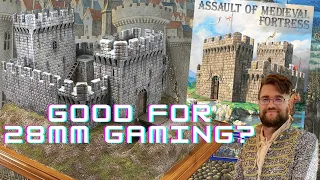
Great thing about 1/72 stuff is that its cheap and accessible. So, is this 1/72 Castle (or as its official name, MiniArt 72033 Assault of Medieval Fortress) usable for 28mm wargaming? Because for price tag of 20-30 USD its nowhere the price an actual 28mm castle would be.
Lets find out with scale comparision with 28mm Perry knight and 28/32mm Palisade from Games Workshop.
___________________________________________
If you enjoyed this video and my content, please consider supporting me on Kofi! - https://ko-fi.com/potan
Or become my Youtube Channel member! - https://www.youtube.com/channel/UCS_e1KVkuo8y1mLwEVI3i9g/join
Or buy wargaming rules from Wargames vault using my refferal link! - https://www.wargamevault.com/browse.php?affiliate_id=1776821
Or get yoursefl some 3D printed Terrain or Miniatures from Proxy Wars using my refferal link! - https://proxywars.us/collections?ref=pD6xy
Disclaimer: All videos are apolitical and this channel is against any form of extremism or hatespeech!
___________________________________________
Official description: The castle is a defensive structure with a compact - usually stone or brick - buildings, which is characteristic of medieval Europe, especially in the period of the full (X-XIII century) and late (XIV-XV century) medieval times. The castle served various functions: the seat of royal, ducal or noble power, it could be the "family home" of a single knight, but also a military outpost subordinate to the royal authority. It is assumed that the first "classic" castles in Europe were built in the 9th century, after the fall of the Carolingian state. In many cases - in today's France or Germany - they had the character of the seat of a ruler or a knight and were often only keep, made of stone. These early castles lack many of the later defensive elements, such as towers or an extensive wall system. However, at the turn of the twelfth and thirteenth centuries, there was a significant change and under the influence of the experience of the Crusades, castles evolve, becoming more and more complex. They begin to have one or more rows of walls. In the territory of Poland, castles appeared at the turn of the 12th and 13th centuries, replacing the previous wooden and earth castles, and one of the first such fortresses is the castle in Legnica or the reconstruction of Wawel in Krakow. It is also worth remembering that the Teutonic castles in Pomerania and Livonia were unusual in their own way, because they were built primarily of brick, not stone. A great example of such a castle is, for example, Malbork. The decline of castles dates back to the 15th century, when the popularization of gunpowder made it possible to acquire them relatively quickly.