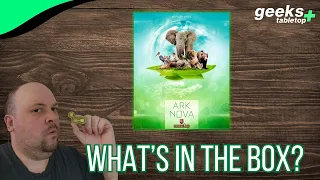
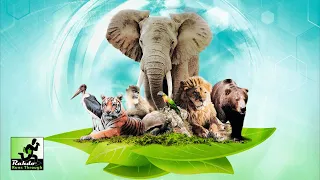
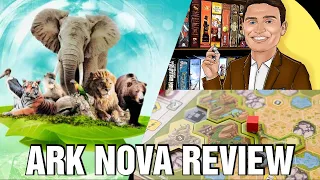
Watch “Episode 15 - Ark Nova: We Built a Zoo!,” a board game review for Ark Nova from Board With Each Other on BoardGameVideo.
Description provided by Board With Each Other on YouTube:
Send us a Text Message. (https://www.buzzsprout.com/twilio/text_messages/2184593/open_sms)
In this episode we cast our critical eye over one of the biggest releases of recent years, the zoo building phenomenon Ark Nova.
We talk about huge deck management, the games mechanics and so satisfying 'cascades that occur during gameplay, how well it plays at two players and of course, trash pandas.
Find us on Social Media
Facebook (https://www.facebook.com/profile.php?id=100091895534339)
Twitter (https://twitter.com/boardweachother)
Instagram (https://www.instagram.com/boardwitheachother/)
Al: Hello, everybody, and welcome to Board With Each Other, the board gaming podcast that looks at board games and reviews board games through the lens of playing them as, a pair, whether that's with a significant other or partner or with a friend or with the denizens of your zoo you're trying to entertain before feeding time. My name is Al Simpson, and I'm joined, as ever, by my lovely co host and player two, Hannah Kelly.
Hannah: Hi, guys.
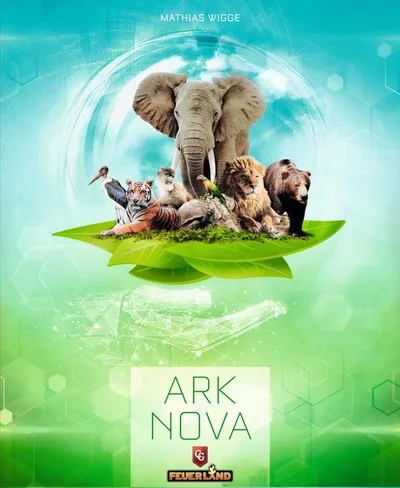
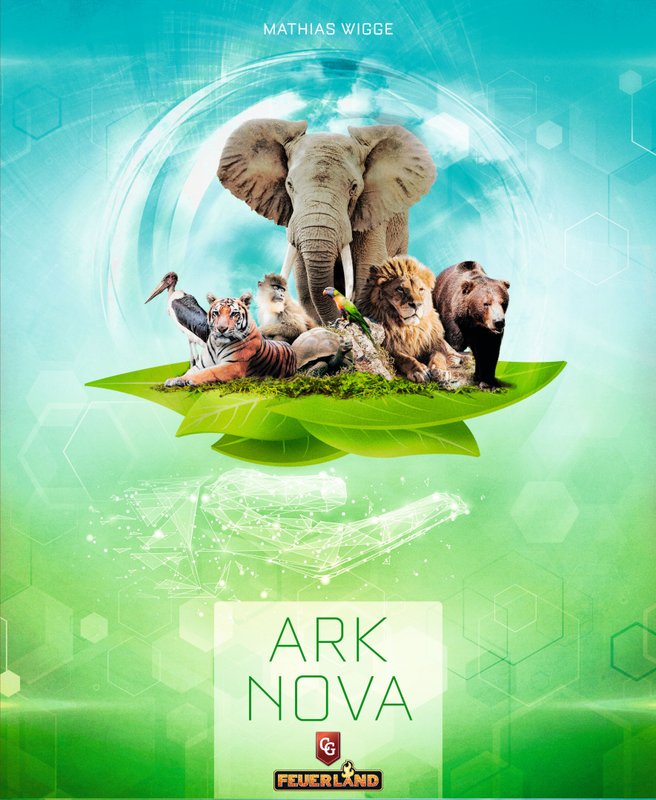
Al: And today we are tackling a big one. We are talking about the zoo building, extravaganza that is Ark Nova.
Hannah: Extravaganza is a good word, I think.
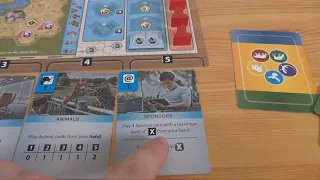
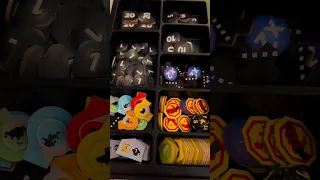
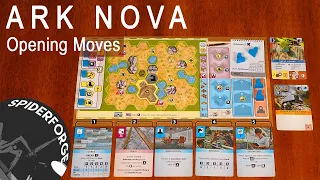
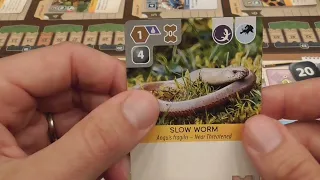
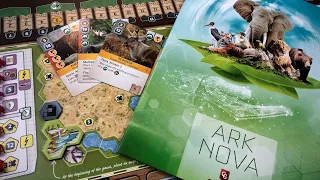
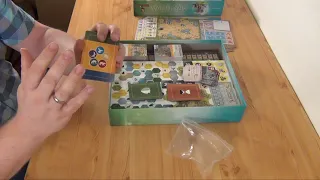
Al: Extravaganza is a good word. Ark Nova is a heavy game. You would call it a euro game. And the concept is you are building a zoo, you are populating that zoo with animals. You are diverting resources to, scientific advancements, and you are working on conservation. The crux of the game is you have two basic score tracks, one for appeal and one for conservation. And what you're trying to do is get them to pass each other as far as possible. So you need to basically be doing both. And you need to do both really, really well in order to win the game. the game's played by each player selecting a zoo map. And, you can either play these symmetrically so everybody has the same map with the same sort of placement bonuses, or you can play it asymmetrically where you have a different zoo map with different bonuses and different sort of mechanisms that go along with it. How you build your zoo is by building enclosures, which is basically achieved through a mechanic where you take tiles from sizes one to five and you place them on a grid. Doing so will get you bonuses if you cover certain spaces and you populate those with animals. The game is played via an action queue. So you have an action queue of five spaces, and on those five spaces are five cards. One allows you to build, one allows you to obtain animals, one allows you to draw more cards or take cards from a marketplace of which they are six cards at all times. Another allows you to either partner up with different countries zoos which have different mechanics, or devote scientific research into your zoo.
Hannah: Donate to conservation projects.
Al: Yes, donate to conservation projects, which is probably the most important, mechanism within the game. Sort of how you win as such, conservation projects net you conservation points, which are quite hard to come by. And, the final action is around sponsorship, so you can get sponsors into your zoo, which acts a bit like animals, but differently they do certain things and certain mechanics within the game. Or money, yes, or gain your money. So there is a, as you just said, sort of a money economy. So you get money every turn. Turns are not your typical back and forth, affair. You have, ah, a tracker called the brake tracker that you, you play back and forth, but a turn only fully ends when the brake tracker reaches zero. And different actions that you take during the game cause the brake tracker to increase. So there's a mechanism for controlling when you get your, your income. Would you get every turn? There's an element of engine building where when you donate to conservation projects, you take, counters away from spaces on your zoo map. And those counters either give you an instant bonus or they give you something every turn when you, when you gain your income. So that's the sort of the engine building side of it. Animals and sponsors and conservation projects. You start the game with some base conservation projects out at the start, but sponsors and animals are gained through an enormous deck of cards. I think there must be about 250 to 300 cards in it. And, you start the game with four of these and you only ever draw new ones when you take an action to do so. When you take actions in your queue, you can take actions at any point within your queue, but the further along it is to the right, the stronger the action is. So, for example, if you took the build action and it was in the sort of one space, you'd be able to build a size one enclosure in the five space. A size five enclosure, that's the simplest encapsulation of it. So you spend a lot of the game sort of weighing up which actions to take. And when you can't just sort of go, ‘I'm just going to keep doing this over and over again’.