1975Jim Dunnigan, Joseph Miranda
- Videos
- 29
- Creators
- 7
Mainly playthroughs
2 players180 min2.4 weight
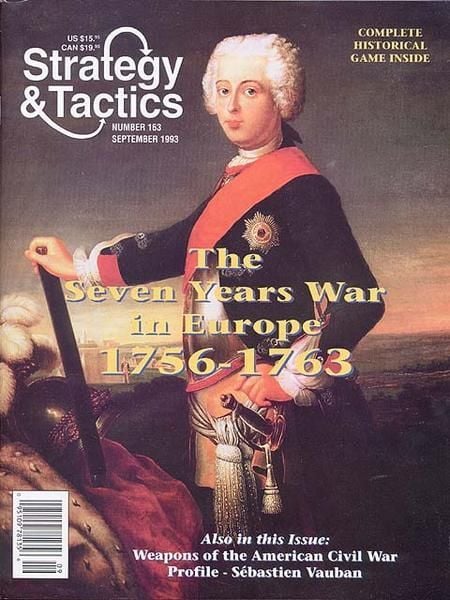
1993Joseph Miranda
From BoardGameGeek
Seven Years War is a simulation of the war between Prussia and a Coalition of European states, 1756-1764, published in Strategy & Tactics #163 (Sep 1993). While militarily a stalemate, the war consolidated Prussia's dominance of central Europe until its defeat at Jena and Auerstadt in 1806. The game is designed for two players or two teams. The Prussian Allied side, opposes the Coalition side. The objective is to gain control of as many central european fortress cities as possible without losing control of your own. The rules consist of a Standard Game that gives a relatively simple but historically valid game, and an Advanced Game providing a more complete historical simulation. Play centers around the operational activity of moving armies, fighting battles and besieging fortresses. However, this operational activity is heavily influenced by, and is intertwined with, the ever changing strategic choices and actions the players take as the game proceeds. This game is falling through the cracks in recent years. There is a reasonably good Cyberboard gamebox but it would be nice if someone would create a Vassal module as well. Operational aspects include leaders, a variable movement table, discipline classes for units, logistics with supply wagons and foraging, and limited intelligence. Forces are comprised of infantry, cavalry, light troops, pioneers and artillery. Combat is modified by battleplan chits, selected before the die is rolled, that allow a player to emphasize line infantry, or more elite units, or cavalry achieving strength bonuses or die roll modifiers. The combat table produces percentage loss and moral checks for one or both sides. One learns that strength is not always the deciding factor. Leadership, high discipline, moral and making use of unit specialization play a big roll. Fortresses can also be captured by siege combat. Strategically, the game makes use of random events, diplomacy, (the various European states get pushed in and out of neutrality and switch sides). Winning battles can give a player diplomatic options. As the game proceeds the progress of both sides is recorded on the Balance of Power track which can also modify victory. It is possible for both sides to achieve a victory. The two are then compared to give a final victory. Also, both sides can lose if the Balance of Power track moves too far toward one of the players. Restraint is part of a player's strategic considerations. The game is complete by magazine game standards. The errata is light. It is not a simple game and it requires players to be willing to roleplay the point of view of the leaders from that period. There is a four turn short scenario covering the first year of the conflict. A full campaign game can last as long as 28 turns if things are drawn out. It is a highly replayable game. Errata and Q&A for 7YW were published in Strategy & Tactics #s 165, 166, 167, and 169. Additional counters for 7YW were included in Strategy & Tactics #s 170 and 171. 7YW also received extensive coverage in Moves #79.

1975Jim Dunnigan, Joseph Miranda
2 players180 min2.4 weight
2004Joseph Miranda
1 - 2 players240 min3.4 weight
2017Eric R. Harvey, Joseph Miranda
1 players0 min3.6 weight
2009Joseph Miranda
1 players240 min3.0 weight
From BoardGameGeek:
Designer
Joseph Miranda
Categories
Mechanics