
2017Dane Beltrami, Corey Konieczka, Christian T. Petersen
- Videos
- 363
- Creators
- 124
Mainly how-to-play and playthroughs
3 - 6 players240 - 480 min4.4 weight
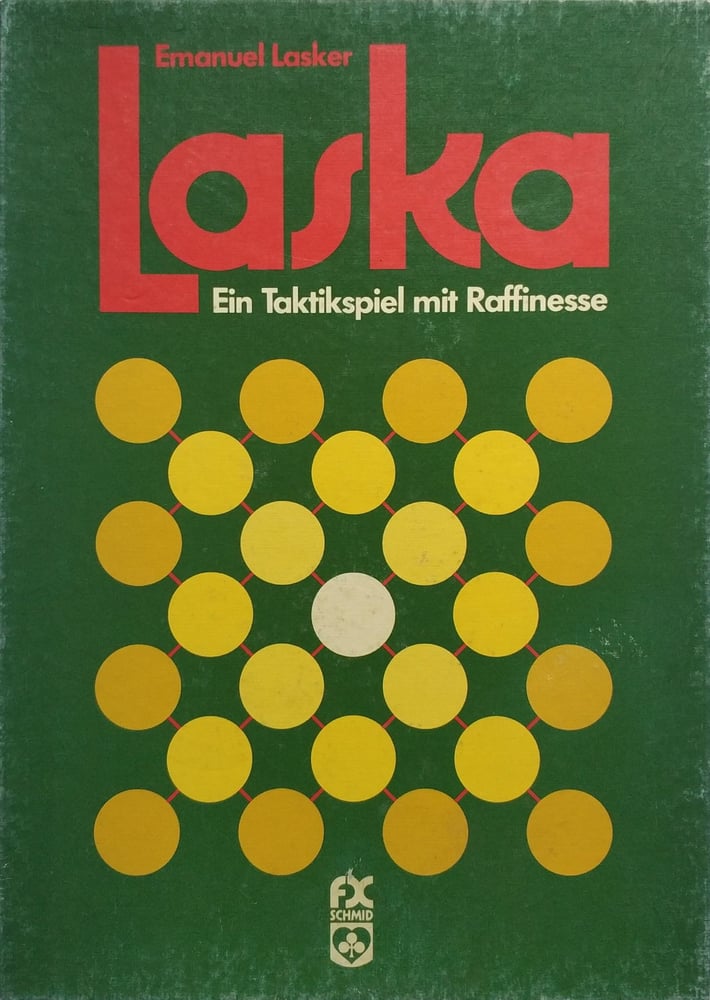
1911Emanuel Lasker
From BoardGameGeek
World Chess Champion Emanuel Lasker developed Laska (a.k.a. Lasca), a variant of the Checkers Family, in 1911. The game board and play resembles that of Checkers, but captured pieces remain on the board and can possibly be freed later in the game. Each player starts the game on the 7x7 board with eleven soldiers. On a turn, a player moves one soldier diagonally forward one space. If a capture is available, then the player must make that capture, trapping the captured piece underneath the capturing one; if the newly captured piece had previously had one or more pieces underneath it, then those pieces are now free to move in future turns. If a soldier reaches the opponent's back row, it's flipped and promoted to an officer, which can move diagonally in all directions. The game continues until either a player can't move or a player has no pieces remaining on the board. In both cases, this player loses the game. Laska was influenced by Bashni.

2017Dane Beltrami, Corey Konieczka, Christian T. Petersen
3 - 6 players240 - 480 min4.4 weight
2017James Ernest, Patrick Rothfuss
2 players20 - 60 min2.4 weight
2015Adam Poots
1 - 4 players60 - 180 min4.3 weight
From BoardGameGeek:
Designer
Emanuel Lasker
Artist
Néstor Romeral Andrés
Categories
Mechanics