Sinai: The Arab-Israeli Wars – '56, '67 and '73

Sinai: The Arab-Israeli Wars – '56, '67 and '73

1973Jim Dunnigan

2 players
210 min
2.6/5 weight

From BoardGameGeek

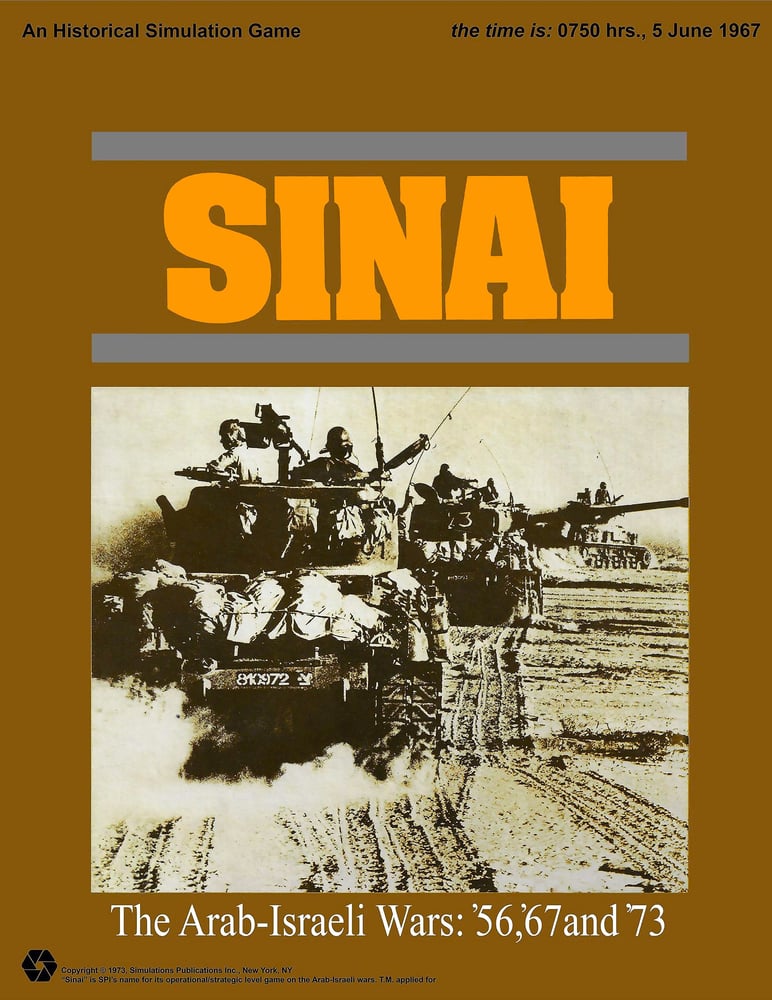
This game is a simulation of real-world events. It is played on a map that is a simplified terrain reproduction of the actual battlefield. A grid of hexagons printed over the map is used to regulate movement and position such as the squares on a chess board. The pieces in the game represent the actual military units that took part in the historical conflict. The large numbers on the pieces indicate the relative strength of these units. Each Player maneuvers his pieces on the map to engage those of the enemy. Battles take place when units are adjacent to enemy units. The total relative strengths of the involved units are compared. The attacking Player consults a simple probability table (the Combat Results Table) to determine the outcome of each battle. First one Player moves his units and conducts attacks, and then the other. The game proceeds this way (for a specified number of turns) as the Players try to achieve the historical objectives set forth in the rules. The final outcome of the game can be very different from the actual historical result. This gives Players a chance to "change history." No prior knowledge of history or military tactics is required to play the game - just a little ingenuity and common sense. -description from the back of the box

There are no videos for this game yet.

Creators who cover this

Curmudgeons with Dice
1 video of this game

Games like this

1975Jim Dunnigan, Joseph Miranda

Videos
29
Creators
7
Mainly playthroughs

2 players180 min2.4 weight
1970Jim Dunnigan

Videos
25
Creators
12
Mainly playthroughs

2 players90 min3.1 weight

1976Jim Dunnigan

Videos
23
Creators
6
Mostly playthroughs

2 players180 - 300 min2.8 weight

About Sinai: The Arab-Israeli Wars – '56, '67 and '73

From BoardGameGeek:

This game is a simulation of real-world events. It is played on a map that is a simplified terrain reproduction of the actual battlefield. A grid of hexagons printed over the map is used to regulate movement and position such as the squares on a chess board. The pieces in the game represent the actual military units that took part in the historical conflict. The large numbers on the pieces indicate the relative strength of these units. Each Player maneuvers his pieces on the map to engage those of the enemy. Battles take place when units are adjacent to enemy units. The total relative strengths of the involved units are compared. The attacking Player consults a simple probability table (the Combat Results Table) to determine the outcome of each battle. First one Player moves his units and conducts attacks, and then the other. The game proceeds this way (for a specified number of turns) as the Players try to achieve the historical objectives set forth in the rules. The final outcome of the game can be very different from the actual historical result. This gives Players a chance to "change history." No prior knowledge of history or military tactics is required to play the game - just a little ingenuity and common sense. -description from the back of the box

Designer

Jim Dunnigan

Artist

Redmond Aksel Simonsen

Categories

Modern WarfareWargame

Mechanics

Dice RollingHexagon GridSimulation
View on BoardGameGeek ›