
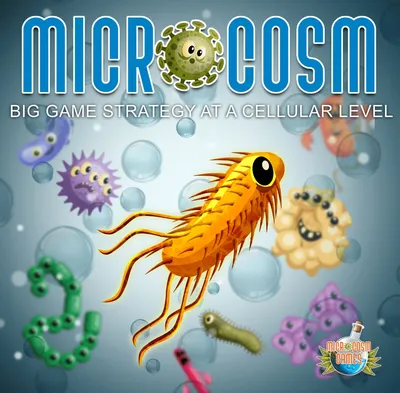
Microcosm
2026Fatima Foflonker
2 - 5 players
60 - 120 min
From BoardGameGeek
In Microcosm, you enter the hidden world of microbial life, harnessing diverse microbes to recycle essential chemicals within a shared ecosystem. By deploying unique microbe cards, you transform resources, gain adaptive mutations, and carve out your ecological niche. Careful planning allows your microbes to grow and multiply, doubling their resources over time-but if a biome exceeds its carrying capacity, the entire cycle can collapse. Players compete and collaborate to drive the carbon, nitrogen, iron, and sulfur cycles across different biomes. Over 12 rounds, players play microbe cards into biome tiles, where each microbe must be able to survive the biome's environmental properties and access the necessary chemical resources to perform a metabolic reaction. When played, microbes convert chemical compounds (resources) from one form to another, beginning or extending a biochemical cycle with the goal of returning the chemical back to the form in the environment (for example, CO₂ → C → CO₂). Often playing cards relies on resources produced by other players' microbes, creating a web of interdependence where timing and positioning are crucial. Each turn, players take one primary action: play a microbe to metabolize available resources or discard a card for an alternate effect. Optional secondary actions-such as claiming objectives or using quorum sensing to gain an additional action-add strategic depth. At the end of each round, doubling time advances; when a microbe's timer reaches zero, its resources replicate exponentially, accelerating both growth and the risk of ecological collapse, which will reduce scoring. A cycle is completed when a series of microbial reactions converts a chemical back to its original form in the biome, rewarding all contributing players with energy points. After scoring, microbes may evolve by gaining mutations from biome or be archived for end-game points. With biomes shifting over time and competition intensifying, victory goes to the player who builds the most efficient, resilient, and adaptable metabolic engine (i.e. most energy/victory points). -description from the designer
All videos

Creators who cover this

Meeple University
1 video of this game
About Microcosm
From BoardGameGeek:
In Microcosm, you enter the hidden world of microbial life, harnessing diverse microbes to recycle essential chemicals within a shared ecosystem. By deploying unique microbe cards, you transform resources, gain adaptive mutations, and carve out your ecological niche. Careful planning allows your microbes to grow and multiply, doubling their resources over time-but if a biome exceeds its carrying capacity, the entire cycle can collapse. Players compete and collaborate to drive the carbon, nitrogen, iron, and sulfur cycles across different biomes. Over 12 rounds, players play microbe cards into biome tiles, where each microbe must be able to survive the biome's environmental properties and access the necessary chemical resources to perform a metabolic reaction. When played, microbes convert chemical compounds (resources) from one form to another, beginning or extending a biochemical cycle with the goal of returning the chemical back to the form in the environment (for example, CO₂ → C → CO₂). Often playing cards relies on resources produced by other players' microbes, creating a web of interdependence where timing and positioning are crucial. Each turn, players take one primary action: play a microbe to metabolize available resources or discard a card for an alternate effect. Optional secondary actions-such as claiming objectives or using quorum sensing to gain an additional action-add strategic depth. At the end of each round, doubling time advances; when a microbe's timer reaches zero, its resources replicate exponentially, accelerating both growth and the risk of ecological collapse, which will reduce scoring. A cycle is completed when a series of microbial reactions converts a chemical back to its original form in the biome, rewarding all contributing players with energy points. After scoring, microbes may evolve by gaining mutations from biome or be archived for end-game points. With biomes shifting over time and competition intensifying, victory goes to the player who builds the most efficient, resilient, and adaptable metabolic engine (i.e. most energy/victory points). -description from the designer
Designer
Fatima Foflonker
Artist
Tristam Rossin
Publisher
Microcosm Games LLC
Categories
Environmental