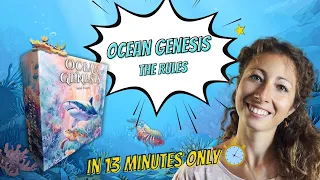

Ocean Genesis

2026

2 - 4 players
15 - 60 min

From BoardGameGeek

In this marine biology themed deck-building game, each player creates their own ecosystem in the Pacific Ocean by placing animals onto compatible substrates and developing a balanced marine community. Victory points can be earned in two main ways. First, substrate cards reward specific categories of animals. By chaining compatible substrates together and successfully placing the right animals on them, players can significantly increase the number of points scored within each animal category-provided they meet the placement requirements. Second, at the start of the game, each player draws a personal board objective that defines a specific spatial pattern. Filling the board according to this template grants additional bonus points at the end of the game. Cards also provide actions that influence the development of ecosystems. There are two types of actions: Immediate actions, which can be triggered when the card is played (unless the card was placed for free). Bonus actions, which are unlocked by paying an additional cost. When the bonus is activated, both the base action and the bonus effect are resolved. These actions may help players expand and optimize their own deck or slow down the progress of their opponents, creating a balance between engine-building and interaction. Throughout the game, players must also adapt to player interactions, environmental disturbances, and the growing pressure of climate change, which can prematurely end the game if ecological thresholds are exceeded. This introduces a tension between competition and limited cooperation to maintain ecosystem stability long enough to score effectively. The game ends in one of two ways: A player completes their ecosystem by filling all substrate spaces with at least one animal (or marine litter). Climate change thresholds are reached, immediately ending the game. Players then total their victory points from substrates, animals, and completed objectives. The player with the highest score wins.

Creators who cover this

Anaïs Martin
Anaïs Martin
2 videos of this game

Games like this

2019Elizabeth Hargrave

Videos
302
Creators
132
Mainly playthroughs and reviews

1 - 5 players40 - 70 min2.5 weight

2019Jamey Stegmaier

Videos
279
Creators
179
Mainly reviews

1 - 5 players90 - 120 min3.0 weight

2024Gary Dworetsky, Anthony Giovannetti, Casey Yano

Videos
263
Creators
93
Mainly playthroughs

1 - 4 players30 - 150 min2.9 weight

1993Richard Garfield

Videos
238
Creators
56
Mainly unboxings

2 - 6 players20 min3.3 weight

About Ocean Genesis

From BoardGameGeek:

In this marine biology themed deck-building game, each player creates their own ecosystem in the Pacific Ocean by placing animals onto compatible substrates and developing a balanced marine community. Victory points can be earned in two main ways. First, substrate cards reward specific categories of animals. By chaining compatible substrates together and successfully placing the right animals on them, players can significantly increase the number of points scored within each animal category-provided they meet the placement requirements. Second, at the start of the game, each player draws a personal board objective that defines a specific spatial pattern. Filling the board according to this template grants additional bonus points at the end of the game. Cards also provide actions that influence the development of ecosystems. There are two types of actions: Immediate actions, which can be triggered when the card is played (unless the card was placed for free). Bonus actions, which are unlocked by paying an additional cost. When the bonus is activated, both the base action and the bonus effect are resolved. These actions may help players expand and optimize their own deck or slow down the progress of their opponents, creating a balance between engine-building and interaction. Throughout the game, players must also adapt to player interactions, environmental disturbances, and the growing pressure of climate change, which can prematurely end the game if ecological thresholds are exceeded. This introduces a tension between competition and limited cooperation to maintain ecosystem stability long enough to score effectively. The game ends in one of two ways: A player completes their ecosystem by filling all substrate spaces with at least one animal (or marine litter). Climate change thresholds are reached, immediately ending the game. Players then total their victory points from substrates, animals, and completed objectives. The player with the highest score wins.

Categories

AnimalsCard GameEnvironmental

Mechanics

Action / EventDeck ConstructionDice RollingEnd Game Bonuses
View on BoardGameGeek ›