2025S J Macdonald, Emanuele Ornella, Shem Phillips
- Videos
- 23
- Creators
- 17
Mainly reviews and how-to-play
1 - 4 players90 minHeavy weight
2009Emanuele Ornella
From BoardGameGeek
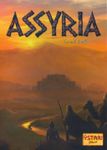
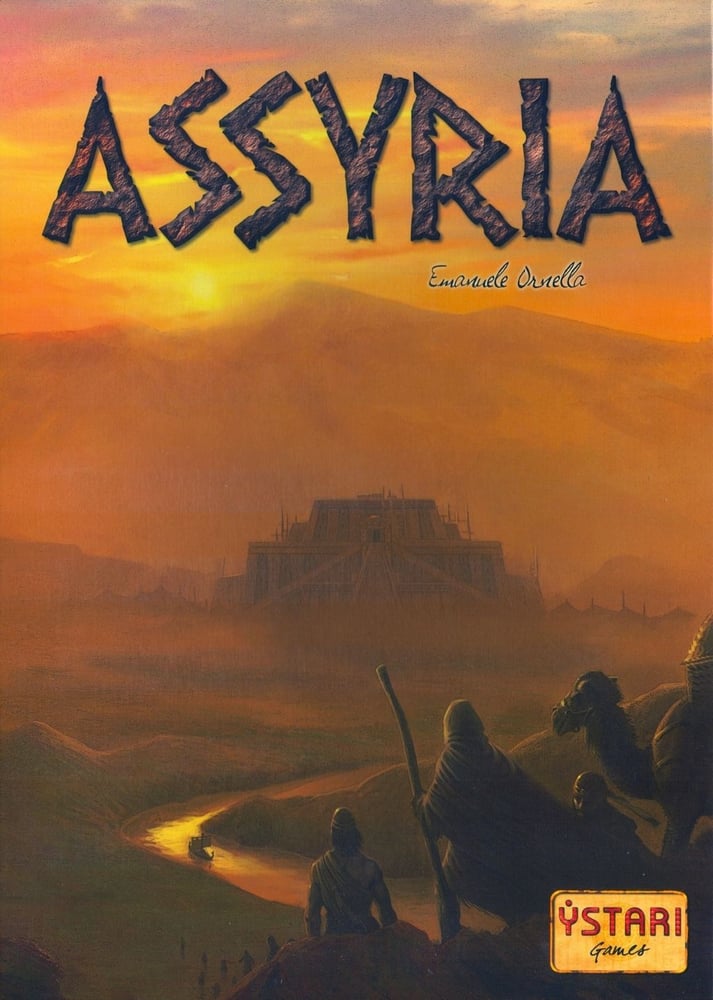
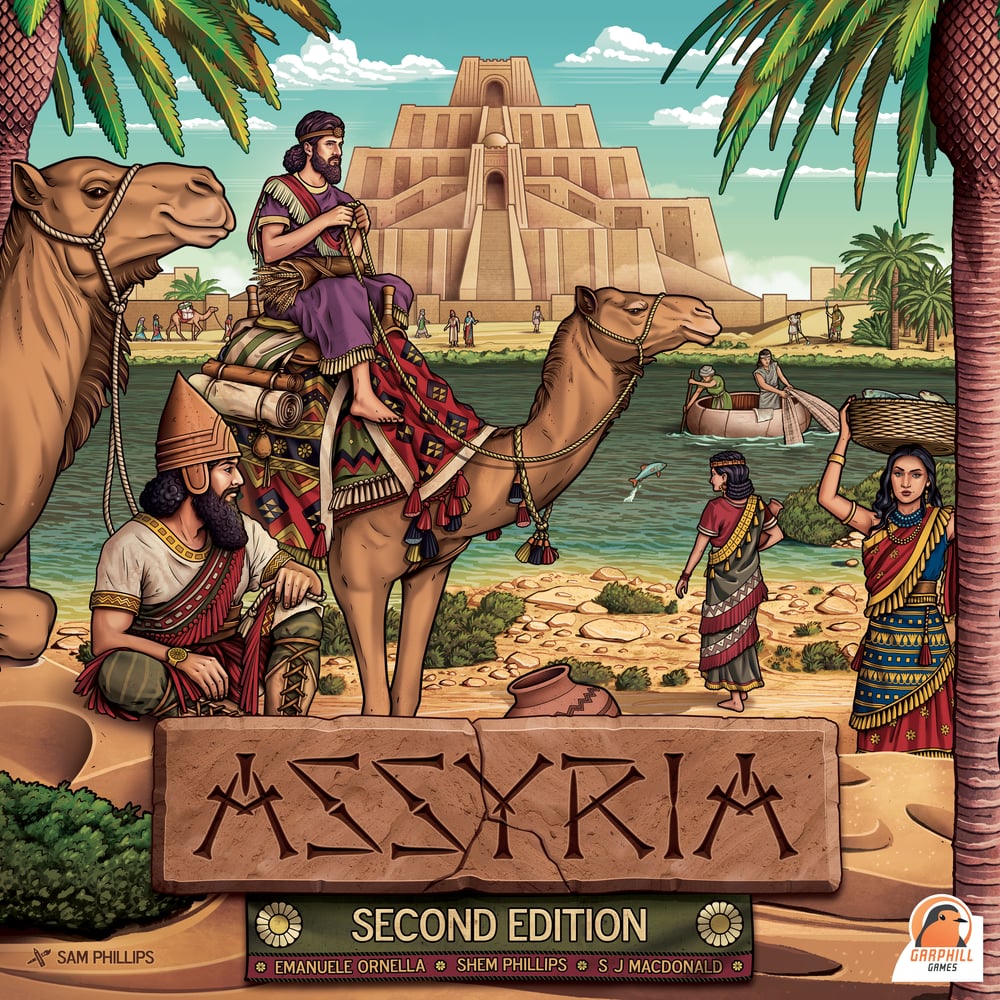
In Assyria, players represent tribes living in Mesopotamia, trying to develop on the desert and a limted fertile area located between two rivers that divide the board. In their quest for power (points), players build Ziggurats (permanent outposts), wells, make sacrifices to gods and try to get along with nobles of Assur - the capital of Assyria. The game is a light-weight eurogame, built around the short-term rapid point gains vs long-term investments dilemma. General flow of play is as follows: Phase 1: Players get resources for expansion and decide on play order In this phase, players pick cards with resources that enable expansion on the board. In general he/she who gets most food, plays last. First player expands with least food. Phase 2: Players expand on the board to earn points or money. Players begin to form strings and/or clusters of huts and pay for placing them with their food cards. Depending on where huts are placed, they either score points or earn camels (money). Phase 3: Players spend money/camels on various investments. A player either goes for one-time bonuses from the nobles of Assur, or makes long-term investments by offerings to gods and building Ziggurats. The game lasts for three eras, made up of 2-3 of such cycles. After each era comes the flood: the board is partially cleaned up, but players also capitalize on their investments from phase 3. Each round, players also score points for huts (those built on fertile land between the two rivers bring more points) and ziggurat tiles. In comparison to other games from Ystari's series - Assyria is lighter than Caylus, Olympos, Ys or Sylla (in terms of complexity, available choices - represented by numerous tiles, cards, icons, cards etc. that need to be remembered and can be combined during play), but heavier than Yspahan, Mykerinos or Metropolis.

2025S J Macdonald, Emanuele Ornella, Shem Phillips
1 - 4 players90 minHeavy weight
2004Emanuele Ornella
2 - 5 players60 minMedium weight
2019Rüdiger Dorn, Mike Elliott, Stefan Feld, Dirk Henn, Emanuele Ornella, Louis-David Péloquin, Michael Rieneck, Marko Ruskowski, Frank Sander, Michael Schacht, Stefan Schiltz, Macel Süßelbeck, Klaus-Jürgen Wrede
2 - 6 players45 - 60 minMedium weight
From BoardGameGeek:
In Assyria, players represent tribes living in Mesopotamia, trying to develop on the desert and a limted fertile area located between two rivers that divide the board. In their quest for power (points), players build Ziggurats (permanent outposts), wells, make sacrifices to gods and try to get along with nobles of Assur - the capital of Assyria. The game is a light-weight eurogame, built around the short-term rapid point gains vs long-term investments dilemma. General flow of play is as follows: Phase 1: Players get resources for expansion and decide on play order In this phase, players pick cards with resources that enable expansion on the board. In general he/she who gets most food, plays last. First player expands with least food. Phase 2: Players expand on the board to earn points or money. Players begin to form strings and/or clusters of huts and pay for placing them with their food cards. Depending on where huts are placed, they either score points or earn camels (money). Phase 3: Players spend money/camels on various investments. A player either goes for one-time bonuses from the nobles of Assur, or makes long-term investments by offerings to gods and building Ziggurats. The game lasts for three eras, made up of 2-3 of such cycles. After each era comes the flood: the board is partially cleaned up, but players also capitalize on their investments from phase 3. Each round, players also score points for huts (those built on fertile land between the two rivers bring more points) and ziggurat tiles. In comparison to other games from Ystari's series - Assyria is lighter than Caylus, Olympos, Ys or Sylla (in terms of complexity, available choices - represented by numerous tiles, cards, icons, cards etc. that need to be remembered and can be combined during play), but heavier than Yspahan, Mykerinos or Metropolis.
Designer
Emanuele Ornella
Artist
Arnaud Demaegd
Publisher
Ystari Games
Categories
Mechanics