
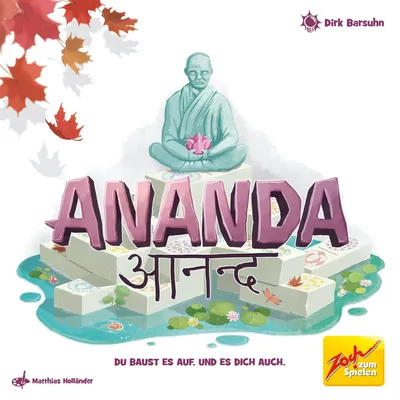
Ananda
2024Dirk Barsuhn
2 - 4 players
30 - 45 min
Light weight: Learn it in minutes
From BoardGameGeek
Balance is the most important thing at Ananda, balance between body and soul, meditation and work, but above all between building and getting new building blocks. In Ananda, players build a temple with 63 domino-style tiles and let their monks meditate there. The larger the colored area built, the more karma points the player can collect. More specifically, at the start of their turn, a player must move their monk to a new colored area on the game board. They then play as many tiles from their hand as they wish, as long as at least one of the tiles is adjacent to their monk, all of the placed tiles expand the color area, and each tile covers precisely two tiles that are on the same level. (Tiles do not need to be on the same level to be part of the same color area.) After you finish placing tiles, count the number of squares that comprise the color area to determine your area value. You may then discard meditation cards of this color from your hand that sum to this number or less. Next, you draw face-down tiles from the reserve equal to the difference between your area value and your meditation value, with your rack holding at most eight tiles. Finally, if you have more tiles on your rack than cards in hand, draw cards from your personal deck to make those numbers match. Once all the tiles have been built, the player who has scored the most karma points with their played meditation cards wins.
Which Ananda video should I watch?
Ananda has 2 videos from 2 creators: 1 review and 1 other video. They date from March to April 2025.
If you like it, try Tea Time Crime, also by Dirk Barsuhn, or Sanssouci, Flamecraft Duals and Superstore 3000, which share several of its mechanics.
All videos
Creators who cover this

BoardGameGeek
1 video of this game

給肥龍一盒桌遊
1 video of this game
Games like this


2025Manny Vega
- Videos
- 44
- Creators
- 33
Mainly reviews and unboxings
1 - 2 players30 - 45 minLight weight

2024Rodrigo Rego
- Videos
- 39
- Creators
- 33
Mainly how-to-play and reviews
2 - 4 players30 - 45 minMedium weight
About Ananda
From BoardGameGeek:
Balance is the most important thing at Ananda, balance between body and soul, meditation and work, but above all between building and getting new building blocks. In Ananda, players build a temple with 63 domino-style tiles and let their monks meditate there. The larger the colored area built, the more karma points the player can collect. More specifically, at the start of their turn, a player must move their monk to a new colored area on the game board. They then play as many tiles from their hand as they wish, as long as at least one of the tiles is adjacent to their monk, all of the placed tiles expand the color area, and each tile covers precisely two tiles that are on the same level. (Tiles do not need to be on the same level to be part of the same color area.) After you finish placing tiles, count the number of squares that comprise the color area to determine your area value. You may then discard meditation cards of this color from your hand that sum to this number or less. Next, you draw face-down tiles from the reserve equal to the difference between your area value and your meditation value, with your rack holding at most eight tiles. Finally, if you have more tiles on your rack than cards in hand, draw cards from your personal deck to make those numbers match. Once all the tiles have been built, the player who has scored the most karma points with their played meditation cards wins.
Designer
Dirk Barsuhn
Artist
Matthias Holländer
Publisher
Zoch Verlag
Mechanics