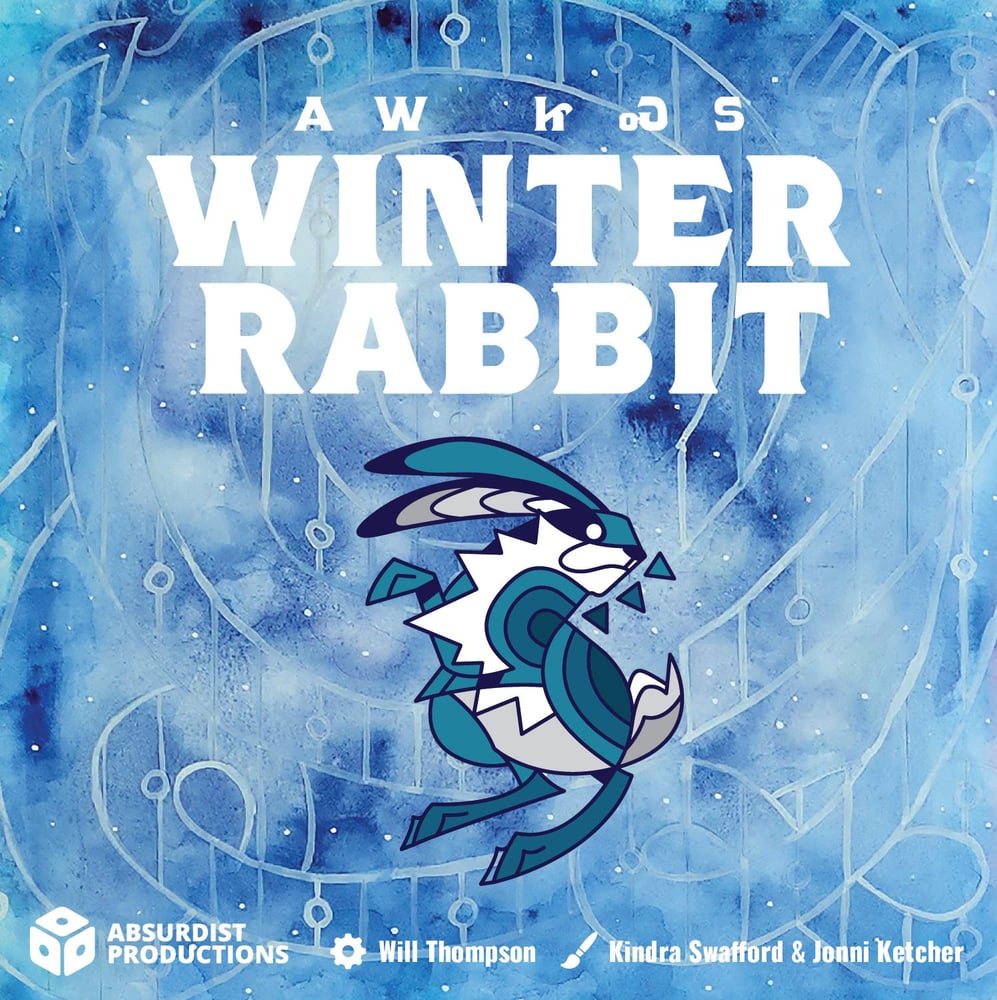
Winter Rabbit
2025William Thompson
2 - 6 players
60 - 120 min
2.5/5 weight
From BoardGameGeek
Winner of the 49th Annual Origins Awards in the light strategy game category. The village elders have predicted a severe winter, so the villagers have agreed to work together to ensure the village has all the necessities. In a spirit of healthy competition, the villagers have decided to compete to see who can be the most helpful. However, Rabbit, the constant trickster, has decided that he does not want to work. Instead, he has decided to confuse everyone else so that he can take all of the resources for himself. Winter Rabbit is set in the world of traditional Cherokee animal stories, where each player takes on the role of one of the animal characters. In this semi-cooperative game, players cooperate to provide everything the village needs for winter while also competing to see who can contribute the most. Winter Rabbit attempts to create a counterpoint to common colonial game themes by focusing on Indigenous values and concepts. Winter Rabbit features a unique hidden worker placement system. Villagers are drawn randomly from a bag. The active player knows whose villager they have drawn and can choose where to place it, though this information is hidden from other players. Resources are only generated when enough villagers are present. When resources are produced, every player gets one, but those with villagers present gain additional resources. Rabbit villagers do not produce resources. When one of these appears in a resource location, resources are instead diverted to the Rabbit Burrow. In later turns, players can steal these resources back. Players can spend resources to build their personal engine through village cards. They can also spend resources on stories that affect the game for all players, or on completing tasks that score points, advance the game, and benefit another player. Players are encouraged to manage resources carefully. Storage is limited, and overproducing can make it difficult to produce resources in future turns. The game ends after a variable number of rounds, depending on player count. If players have collectively produced enough supplies for the village to survive Winter, then the player with the highest score wins. If Winter arrives before the necessary supplies are produced, then players share a collective loss. -description from designer
All videos

Creators who cover this

Bangers Project
1 video of this game

Beyond Solitaire
1 video of this game

Drive Thru Games
1 video of this game
Games like this


2021Kamil 'Sanex' Cieśla, Robert Plesowicz, Łukasz Włodarczyk
- Videos
- 99
- Creators
- 48
Mainly reviews and unboxings
1 - 4 players120 - 180 min3.9 weight

2026Ben Rosset
- Videos
- 52
- Creators
- 31
Mainly reviews and unboxings
1 - 6 players60 - 90 min2.9 weight

2012Christophe Boelinger
- Videos
- 47
- Creators
- 30
Mostly playthroughs and reviews
2 - 5 players30 - 240 min3.7 weight
About Winter Rabbit
From BoardGameGeek:
Designer
William Thompson
Artist
Kindra Swafford
Categories
AnimalsEnvironmentalFarming
Mechanics
Semi-Cooperative GameWorker Placement