












2019Martino Chiacchiera, Hjalmar Hach, Pierluca Zizzi
- Videos
- 94
- Creators
- 51
Mainly reviews and unboxings
2 - 8 players10 - 15 minLight weight
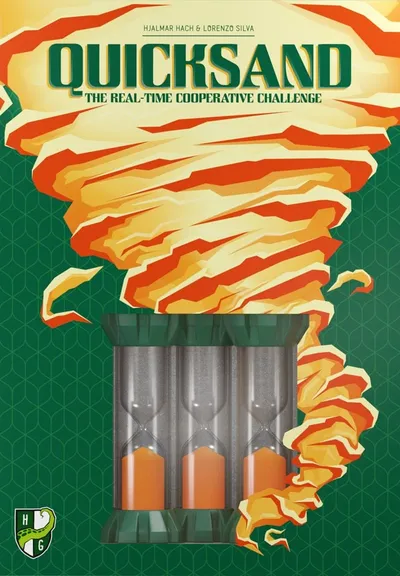
2023Hjalmar Hach, Lorenzo Silva
Mostly reviews and how-to-play. Quicksand is covered on BoardGameVideo.com by 6 reviews, 5 how-to-play guides, 3 recorded sessions, and 1 unboxings.
From BoardGameGeek
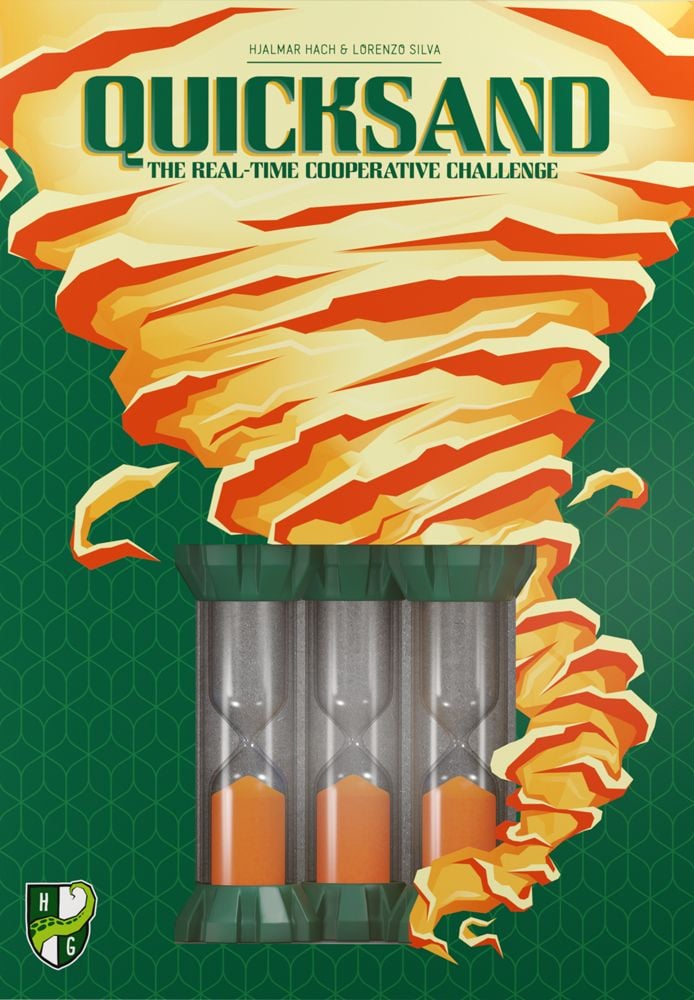
Quicksand is a real-time co-operative game in which players work together to deactivate the "Quicksand", a dangerous trap of gears and sand. You can't just race as quickly as possible, though, because you must avoid setting off the trap. To set up, choose one of the 20+ scenarios, then lay out the gear tiles in the specified path and place the appropriate sand timers - which have different amounts of sand in them - on the first gears of the path. (The path might have obstacles on it based on the particular scenario.) Gears feature both a color (orange, yellow, gray) and a shape (square, circle, crescent). Each player starts with a hand of three cards, with a card showing one of the three colors, one of the three shapes, or a sand timer. Once the game starts, players play a card in turn to try to advance the sand timers and keep them from running out, refilling their hand after they play. When you play a color or shape card, you flip all of the sand timers currently on this color/shape, advancing them one space on the path if that next space is empty. When you play a sand timer card, you flip any one timer, advancing it, if possible. (If no timers are on gears matching the played card, nothing happens.) If a sand timer runs out, flip it and place it next to the gear on which it was previously located. If someone plays a sand timer card, they can recover this timer by flipping and placing it back onto the gear - but only if that tile is empty. If a set-aside timer runs out again, players lose the game. Once a timer reaches the last open space on the path, played cards matching that gear's color/shape will flip it - and if it runs out, you lose the game with no chance of recovery. If the sand timers fill the final gear tiles on the path without this happening, you win!
Quicksand has 15 videos from 10 creators: 6 reviews, 5 how-to-play guides, 3 playthroughs and 1 unboxing. They date from 2023 to July 2026.
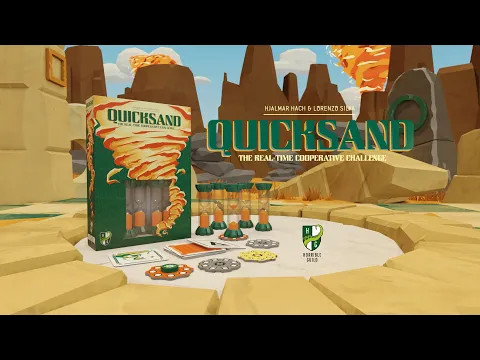
To learn the rules, start with "Quicksand | Reveal Trailer" by Horrible Guild, which runs 1 min.
For an opinion before you buy, start with "Quicksand Review - It Gets Everywhere!" by The Dice Tower. 5 creators have reviewed it. To see it played, watch "Quicksand Live Play" by The Dice Tower, one of 3 playthroughs.
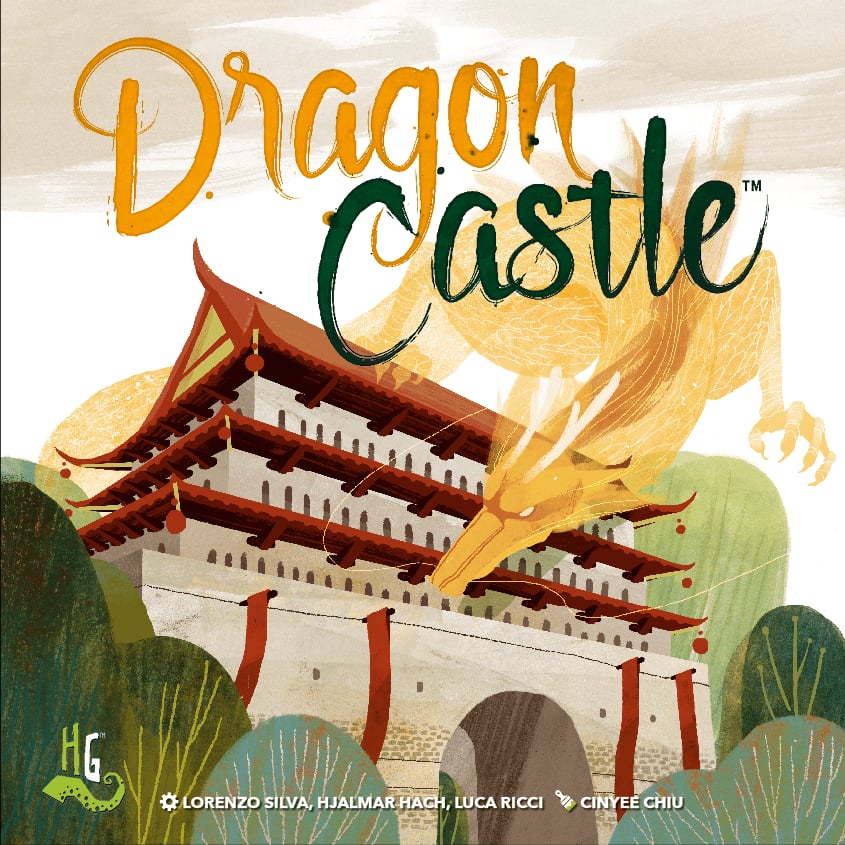
If you like it, try Similo, Photosynthesis, Dragon Castle and The King's Dilemma, also by Hjalmar Hach.
8 of 10


2019Martino Chiacchiera, Hjalmar Hach, Pierluca Zizzi
2 - 8 players10 - 15 minLight weight
2017Hjalmar Hach
2 - 4 players30 - 60 minMedium weight
2017Hjalmar Hach, Luca Ricci, Lorenzo Silva
1 - 4 players30 - 45 minMedium weight
2019Hjalmar Hach, Lorenzo Silva
3 - 5 players45 - 60 minMedium weight
From BoardGameGeek:
Quicksand is a real-time co-operative game in which players work together to deactivate the "Quicksand", a dangerous trap of gears and sand. You can't just race as quickly as possible, though, because you must avoid setting off the trap. To set up, choose one of the 20+ scenarios, then lay out the gear tiles in the specified path and place the appropriate sand timers - which have different amounts of sand in them - on the first gears of the path. (The path might have obstacles on it based on the particular scenario.) Gears feature both a color (orange, yellow, gray) and a shape (square, circle, crescent). Each player starts with a hand of three cards, with a card showing one of the three colors, one of the three shapes, or a sand timer. Once the game starts, players play a card in turn to try to advance the sand timers and keep them from running out, refilling their hand after they play. When you play a color or shape card, you flip all of the sand timers currently on this color/shape, advancing them one space on the path if that next space is empty. When you play a sand timer card, you flip any one timer, advancing it, if possible. (If no timers are on gears matching the played card, nothing happens.) If a sand timer runs out, flip it and place it next to the gear on which it was previously located. If someone plays a sand timer card, they can recover this timer by flipping and placing it back onto the gear - but only if that tile is empty. If a set-aside timer runs out again, players lose the game. Once a timer reaches the last open space on the path, played cards matching that gear's color/shape will flip it - and if it runs out, you lose the game with no chance of recovery. If the sand timers fill the final gear tiles on the path without this happening, you win!
Designers
Hjalmar Hach, Lorenzo Silva
Artist
Maxime Morin
Publisher
Horrible Guild
Mechanics