boardgamevideo
  • Trending
  • Videos
  • Games
  • Channels
  • Lists
  • Shorts

Explore

  • Home
  • Trending
  • Channels
  • Videos
  • Games
  • Lists
  • Shorts
  • Conventions
  • Year in Review

Browse by type

  • Reviews
  • How to play
  • Playthroughs
  • Unboxing
  • Top 100 lists
  • Featured videos
  • Trending this week
  • Rising games
  • Games with fresh review perspectives

Information

  • About
  • Contact
  • Terms & Conditions
  • Privacy Policy

© 2022–2026 BoardGameVideo.com

Powered by BGG
  • Videos
  • Trending
  • Shorts
  • Channels
  • Games
  • Lists
Himalaya

Himalaya

2004·Régis Bonnessée

3 - 4 players
60 min
Medium weight: Teach it in one sitting

From BoardGameGeek

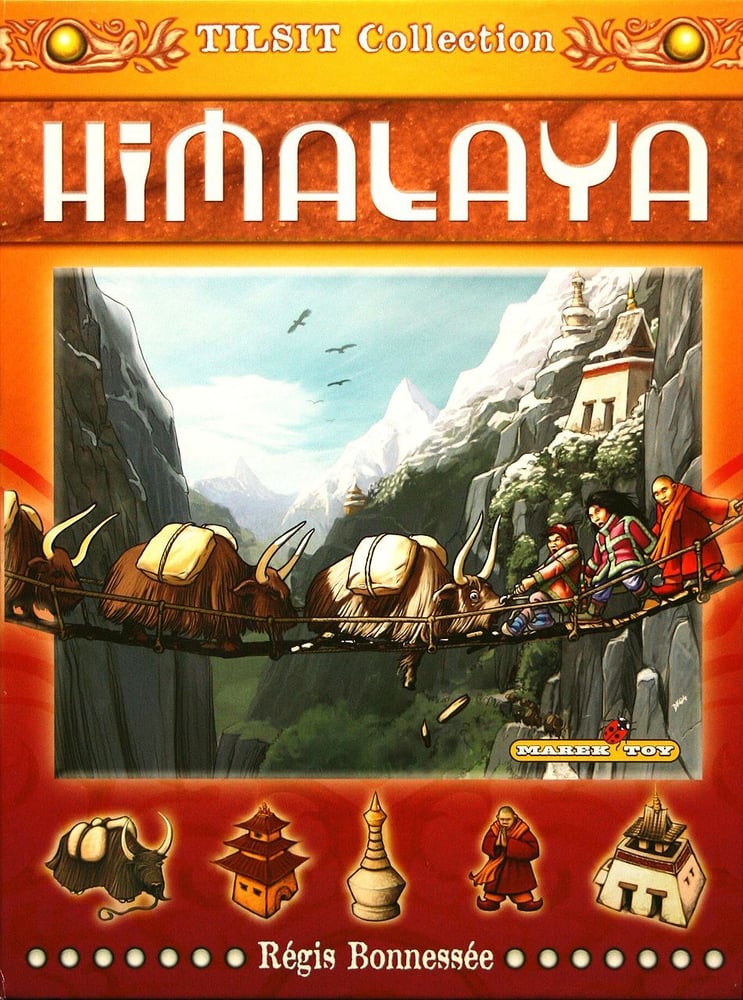
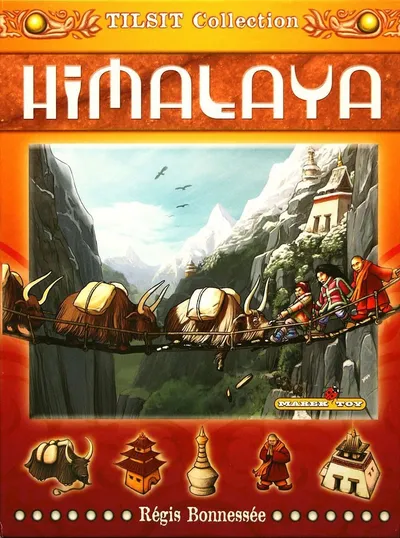
As the Chief of a Himalayan high plateau tribe; Dolpo-pa, Bhotia, Sherpa, or Tamang, you lead your yak's caravan from one village to another through snowy crests and risky paths in order to collect the goods necessary to the development of your tribe. Meanwhile, you will increase the political, religious and economical influence of your tribe. By collecting goods (salt, barley, tea, jade, and gold), you can make offers to monasteries, send out delegations to different regions or bargain to increase your livestock. All this to become the most prosperous caravaneer in all of the Himalaya! Players program their caravans around the paths on the Himalayan plateau to collect various goods, and then deliver them. Each turn players plan in advance six moves for their caravan, trying to second-guess what other players will do to their best advantage. Delivering goods allows the player to increase their influence in one of three separate categories - each delivery allows you to advance your position in two of the three categories. Religious influence is marked by the number and value of your stupas in buildings on the board, political influence is marked by the number of sherpas you have in the regions between the paths on the board, and economical influence is marked by the total number of yaks you have on your delivery disks. The scoring is unique to the game, in the 4 player game anyway (the player count the game is primarily designed to be played with). To determine the winner you first score up religious influence, and the player with the least religious influence is eliminated, and their remaining pieces are removed from the board. Next the player with the least political influence is eliminated. The remaining two players decide the winner by who has the greatest economic influence. This unusual scoring is what makes this game different from many other similar games.

Himalaya

Watch first

Learn to play

The Edge of the Board - Himalaya Tutorial and Review20:56

The Edge of the Board - Himalaya Tutorial and Review

Review

Review & Brief Tutorial - Episode 59: "Guessing & Stressing"28:28

Review & Brief Tutorial - Episode 59: "Guessing & Stressing"

Undiscovered Games

Undiscovered Games

Which Himalaya video should I watch?

Himalaya has 3 videos from 2 creators: 1 review and 2 how-to-play guides. They date from 2012 to February 2025.

To learn the rules, start with "The Edge of the Board - Himalaya Tutorial and Review", which runs 21 min. For a quicker teach, "[Jugando con Ketty] Himalaya" runs 12 min.

For an opinion before you buy, start with "Review & Brief Tutorial - Episode 59: "Guessing & Stressing"" by Undiscovered Games.

If you like it, try Altered, Dice Forge, Altered: Skybound Odyssey and Altered: Seeds of Unity, also by Régis Bonnessée.
All videos

The Edge of the Board - Himalaya Tutorial and ReviewHow to play20:56

The Edge of the Board - Himalaya Tutorial and Review

[Jugando con Ketty] HimalayaHow to play11:30

[Jugando con Ketty] Himalaya

Review & Brief Tutorial - Episode 59: "Guessing & Stressing"Review28:28

Review & Brief Tutorial - Episode 59: "Guessing & Stressing"

Undiscovered Games

Undiscovered Games

Creators who cover this

All channels
Undiscovered Games
Undiscovered Games
1 video of this game

Games like this

All games

Altered

2024·Régis Bonnessée, Nathanaël Dufour, Jacques Ernoult, Merlin Ismet, François Jourdain, Marcus Kearsey, Léa Roulée, Manuel Rozoy, Timothée Simonot, Charles Wickham

Videos
85
Creators
47
Mainly reviews and how-to-play

2 - 4 players·10 - 40 min·Medium weight

Dice Forge

2017·Régis Bonnessée

Videos
7
Creators
6
Mostly unboxings and reviews

2 - 4 players·45 min·Medium weight

Altered: Skybound Odyssey

2025·Régis Bonnessée, Nathanaël Dufour, Jacques Ernoult, Merlin Ismet, François Jourdain, Marcus Kearsey, Léa Roulée, Manuel Rozoy, Timothée Simonot, Charles Wickham

Videos
7
Creators
3
Mostly reviews

2 players·20 - 40 min·Heavy weight

Altered: Seeds of Unity

2026·Régis Bonnessée, Nathanaël Dufour, Jacques Ernoult, Merlin Ismet, Chad Jensen, François Jourdain, Marcus Kearsey, Léa Roulée, Manuel Rozoy, Timothée Simonot

Videos
4
Creators
2
Mostly how-to-play

2 players·20 - 40 min·Heavy weight

About Himalaya

From BoardGameGeek:

As the Chief of a Himalayan high plateau tribe; Dolpo-pa, Bhotia, Sherpa, or Tamang, you lead your yak's caravan from one village to another through snowy crests and risky paths in order to collect the goods necessary to the development of your tribe. Meanwhile, you will increase the political, religious and economical influence of your tribe. By collecting goods (salt, barley, tea, jade, and gold), you can make offers to monasteries, send out delegations to different regions or bargain to increase your livestock. All this to become the most prosperous caravaneer in all of the Himalaya! Players program their caravans around the paths on the Himalayan plateau to collect various goods, and then deliver them. Each turn players plan in advance six moves for their caravan, trying to second-guess what other players will do to their best advantage. Delivering goods allows the player to increase their influence in one of three separate categories - each delivery allows you to advance your position in two of the three categories. Religious influence is marked by the number and value of your stupas in buildings on the board, political influence is marked by the number of sherpas you have in the regions between the paths on the board, and economical influence is marked by the total number of yaks you have on your delivery disks. The scoring is unique to the game, in the 4 player game anyway (the player count the game is primarily designed to be played with). To determine the winner you first score up religious influence, and the player with the least religious influence is eliminated, and their remaining pieces are removed from the board. Next the player with the least political influence is eliminated. The remaining two players decide the winner by who has the greatest economic influence. This unusual scoring is what makes this game different from many other similar games.

Designer

Régis Bonnessée

Artists

Johann Aumaitre, David Cochard

Publisher

Tilsit

Categories

EconomicMedievalPolitical

Mechanics

Programmed ActionsArea Majority / InfluencePick-up and DeliverSet Collection
View on BoardGameGeek ›
Home
Games
Himalaya
cached: 3800