
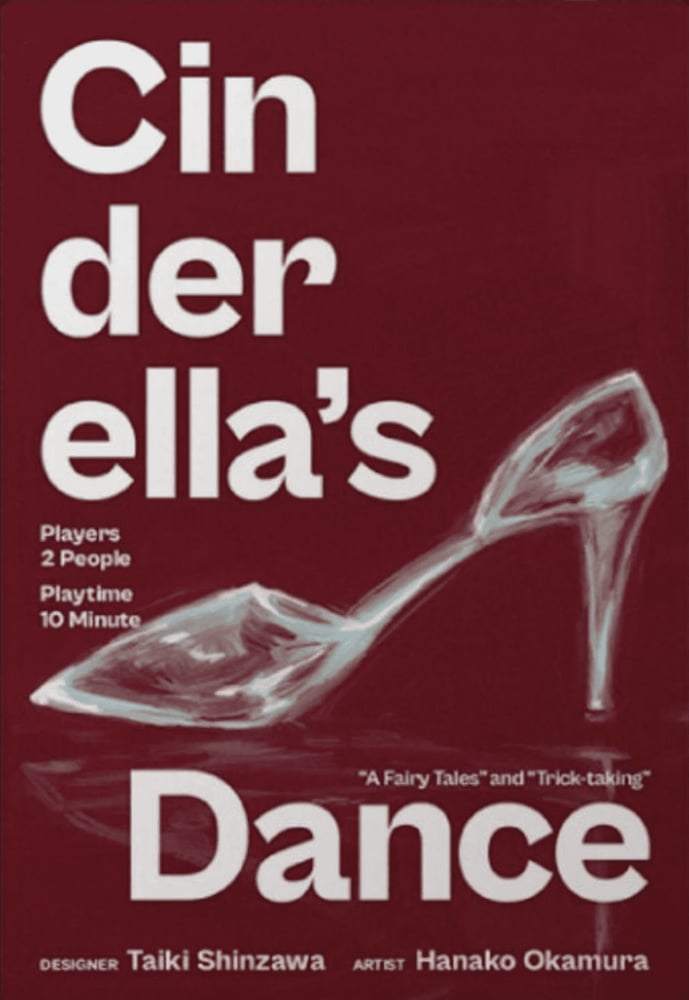
Cinderella's Dance

Cinderella's Dance

2019新澤 大樹 (Taiki Shinzawa)

2 players
10 min
1.0/5 weight

From BoardGameGeek

Cinderella's Dance was first released under the name Count Up 21 at a January 2019 event called "これはトリテなのか?" ("Is This a Trick-Taking Game?"). This two-player game may or may not be a trick-taking game, and is, in a sense, intended to live on the edge. The game consists of a deck of cards (numbered 1-21) and two optional scoring cards. To set up a round, shuffle the cards, remove five from play, then deal each player eight cards. The starting player plays any card, then the next player either plays a card at most three higher than the previous card - so on a play of 5, the next player could play 6, 7, or 8 - or passes. When a player passes, the previous player collects the played cards, stacks them as a scored trick, then leads a card. When a player is out of cards, you resolve the current trick, then the player who has collected more tricks wins the round; in case of a tie, the player who collected the last trick wins. The first player to win three rounds wins the game.

Creators who cover this

Stonemaier Games
Stonemaier Games
1 video of this game
The Dice Tower
The Dice Tower
1 video of this game
ThinkerThemer
ThinkerThemer
1 video of this game

Games like this

2019新澤 大樹 (Taiki Shinzawa)

Videos
16
Creators
10
Mainly reviews

3 - 4 players40 min2.3 weight
2014Jun Sasaki, 新澤 大樹 (Taiki Shinzawa)

Videos
14
Creators
12
Mainly reviews and how-to-play

2 - 6 players20 min1.8 weight

2015新澤 大樹 (Taiki Shinzawa)

Videos
10
Creators
10
Mostly reviews

3 - 4 players20 - 30 min1.5 weight

2025新澤 大樹 (Taiki Shinzawa)

Videos
8
Creators
8
Mainly reviews

2 - 5 players40 min2.2 weight

About Cinderella's Dance

From BoardGameGeek:

Cinderella's Dance was first released under the name Count Up 21 at a January 2019 event called "これはトリテなのか?" ("Is This a Trick-Taking Game?"). This two-player game may or may not be a trick-taking game, and is, in a sense, intended to live on the edge. The game consists of a deck of cards (numbered 1-21) and two optional scoring cards. To set up a round, shuffle the cards, remove five from play, then deal each player eight cards. The starting player plays any card, then the next player either plays a card at most three higher than the previous card - so on a play of 5, the next player could play 6, 7, or 8 - or passes. When a player passes, the previous player collects the played cards, stacks them as a scored trick, then leads a card. When a player is out of cards, you resolve the current trick, then the player who has collected more tricks wins the round; in case of a tie, the player who collected the last trick wins. The first player to win three rounds wins the game.

Designer

新澤 大樹 (Taiki Shinzawa)

Artists

Haruka Hiramoto, Keisuke Nakamura, 桑江 美沙穂 (Misaho Kuwae)

Categories

Card Game

Mechanics

Hand ManagementTrick-taking
View on BoardGameGeek ›