Hexagonal Chess

Hexagonal Chess

1936Władyslaw Gliński

2 players
40 min
3.9/5 weight

From BoardGameGeek

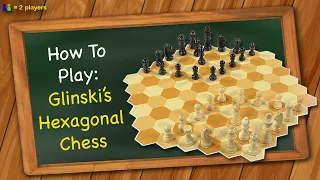
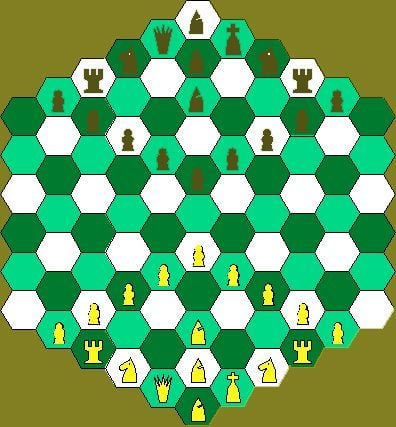
Over the years a number of chess variants have been proposed for boards featuring hexagonally shaped cells (commonly called hexes). The most popular of these is Hexagonal Chess which was invented in 1936 by Wladyslaw Glinski of Poland. David Pritchard says, in the Encyclopedia of Chess Variants, that Glinski's game is played by over half-a-million people, mostly in Eastern Europe. It features a hexagonally-shaped (of course) 3-colour board. Otherwise, it differs from traditional chess in that it has 9 pawns and three bishops--one for each colour. The set-up naturally varies from that of a square board, but beyond that, much of the play is fairly similar.

Creators who cover this

CGP Grey
CGP Grey
1 video of this game
Triple S Games
Triple S Games
1 video of this game

About Hexagonal Chess

From BoardGameGeek:

Over the years a number of chess variants have been proposed for boards featuring hexagonally shaped cells (commonly called hexes). The most popular of these is Hexagonal Chess which was invented in 1936 by Wladyslaw Glinski of Poland. David Pritchard says, in the Encyclopedia of Chess Variants, that Glinski's game is played by over half-a-million people, mostly in Eastern Europe. It features a hexagonally-shaped (of course) 3-colour board. Otherwise, it differs from traditional chess in that it has 9 pawns and three bishops--one for each colour. The set-up naturally varies from that of a square board, but beyond that, much of the play is fairly similar.

Designer

Władyslaw Gliński

Categories

Abstract Strategy

Mechanics

Grid Movement
View on BoardGameGeek ›