Anti-Monopoly
1973Ralph Anspach
2 - 6 players
120 min
Light weight: Learn it in minutes
From BoardGameGeek
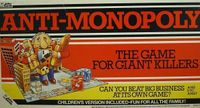
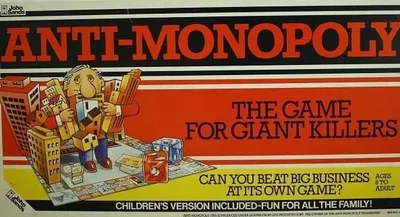
(Note: Not to be confused with Anti-Monopoly II. Please be careful when submitting new versions of this game; basically, anything published after 1987 will almost certainly be Anti-Monopoly II and belong to that game, even if it's called "Anti-Monopoly". As for the reasons why this is so, please see the clarifications at the end of this article and the article of Anti-Monopoly II.) The "Bust~the~Trust!" Game The basic idea of the game is to end the monopolistic practices of the 3-company-combinations of the game board. The players are Trust-Busting lawyers going about the board slapping lawsuits on the monopolies. The winning trust buster is the one who ends with the largest number of social-credit points when one of the players runs out of money. There are 3 kinds of company combinations on the board: Oligopolies, Trusts and Monopolies, marked by one, two and three "accusation circles" respectively. "Accusing" is done by placing a small, round chip of the same color as your token on such a circle. When all accusation circles of a combination are covered, the monopolistic practices of that combination have been ended. An accusation chip can be bought from the "Budget-Commissioner"; when lending money, he provides a Social-Credit card as an IOU. Variant rules are supplied for a Low-Budget Game and a Trading Game. Anspach fought --and won-- a vicious court battle against Hasbro (and others) over this game. Anti-Monopoly was briefly (1976-1982) published as "Anti" and "Anti-Monopoly II" was published as "Choice" whilst the company was forbidden to use the word "Monopoly". In 1984 after prevailing in court the company used the names "Anti-Monopoly" and "Anti-Monopoly II" for its two games. In 1987, Anti-Monopoly was withdrawn and Anti-Monopoly II was renamed "Anti-Monopoly". The game described here was produced as Anti-Monopoly before 1976 and from 1984 thru 1987. The game produced as Anti-Monopoly after 1987 is a different game, with the same name. Plenty of potential for confusion there, eh?
Creators who cover this

Board Game Museum
1 video of this game
Games like this
2007Wolfgang Kramer, Markus Lübke
- Videos
- 35
- Creators
- 31
Mainly reviews
3 - 5 players60 - 90 minMedium weight
1935Charles Darrow, Elizabeth J. Magie (Phillips)
- Videos
- 96
- Creators
- 70
Mainly reviews and how-to-play
2 - 8 players60 - 180 minLight weight
About Anti-Monopoly
From BoardGameGeek:
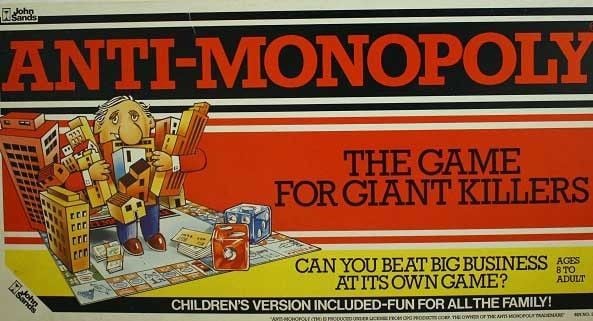
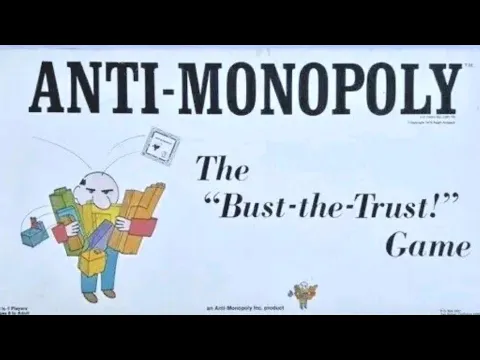
(Note: Not to be confused with Anti-Monopoly II. Please be careful when submitting new versions of this game; basically, anything published after 1987 will almost certainly be Anti-Monopoly II and belong to that game, even if it's called "Anti-Monopoly". As for the reasons why this is so, please see the clarifications at the end of this article and the article of Anti-Monopoly II.) The "Bust~the~Trust!" Game The basic idea of the game is to end the monopolistic practices of the 3-company-combinations of the game board. The players are Trust-Busting lawyers going about the board slapping lawsuits on the monopolies. The winning trust buster is the one who ends with the largest number of social-credit points when one of the players runs out of money. There are 3 kinds of company combinations on the board: Oligopolies, Trusts and Monopolies, marked by one, two and three "accusation circles" respectively. "Accusing" is done by placing a small, round chip of the same color as your token on such a circle. When all accusation circles of a combination are covered, the monopolistic practices of that combination have been ended. An accusation chip can be bought from the "Budget-Commissioner"; when lending money, he provides a Social-Credit card as an IOU. Variant rules are supplied for a Low-Budget Game and a Trading Game. Anspach fought --and won-- a vicious court battle against Hasbro (and others) over this game. Anti-Monopoly was briefly (1976-1982) published as "Anti" and "Anti-Monopoly II" was published as "Choice" whilst the company was forbidden to use the word "Monopoly". In 1984 after prevailing in court the company used the names "Anti-Monopoly" and "Anti-Monopoly II" for its two games. In 1987, Anti-Monopoly was withdrawn and Anti-Monopoly II was renamed "Anti-Monopoly". The game described here was produced as Anti-Monopoly before 1976 and from 1984 thru 1987. The game produced as Anti-Monopoly after 1987 is a different game, with the same name. Plenty of potential for confusion there, eh?