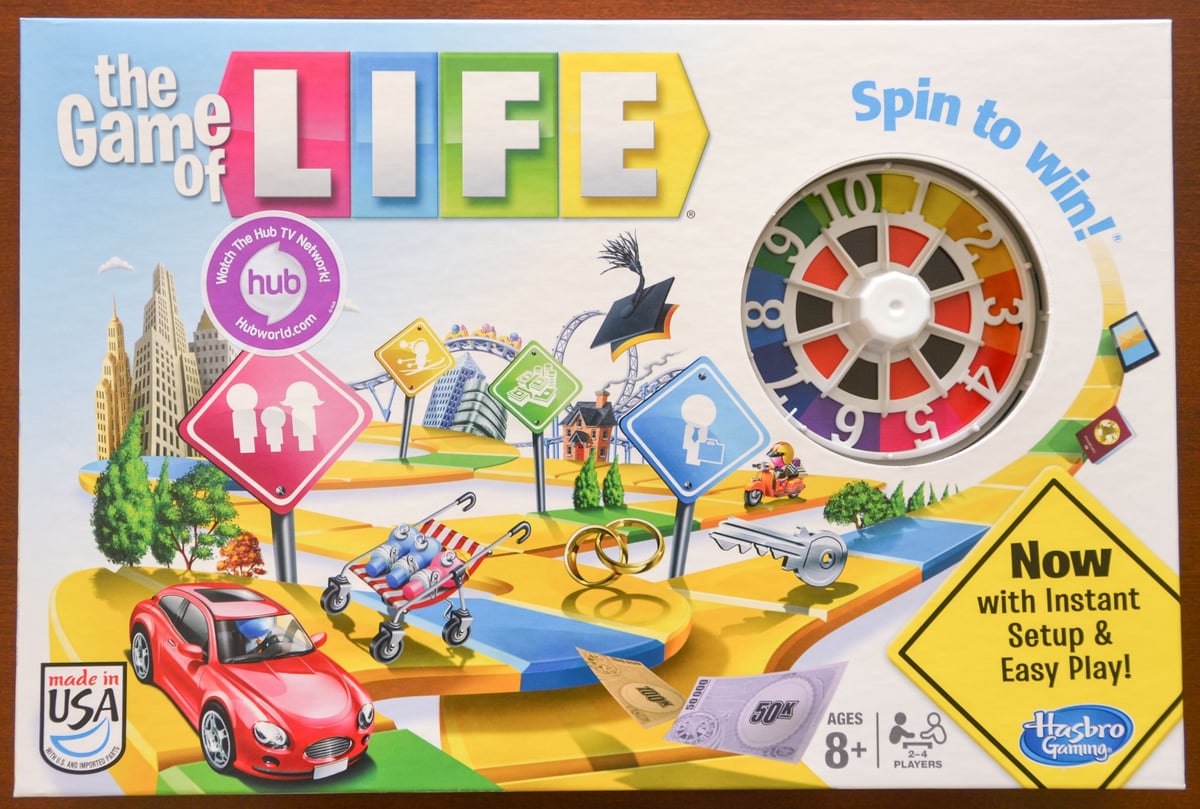
The Game of Life (2013- Editions)

The Game of Life (2013- Editions)

2013

2 - 4 players
60 min
1.2/5 weight

From BoardGameGeek

This game attempts to mirror life events many people go through from going to college, raising a family, buying a home, working and retiring. The intent of the game is to have the most assets at the end of the game. Assets are earned primarily by passing Payday spots on the game board. Money is also earned (and sometimes lost) by drawing Action cards, which assign set amounts or multiples of the wheel spin. There is a very linear board that you move along by spinning a wheel. There are a handful of intersections where you can choose to go one direction or another but they ultimately have similar spaces and meet back up quickly. The first one is a decision to either attend college (payment due and a longer track), or not - with different career cards drawn as a result of that decision. There are a handful of choices regarding house speculation, but for the most part it is a game of luck. This game makes a number of updates to older games in the game family. The maximum number of players has been reduced from 6 to 4, and a number of new cards and concepts have been introduced, increasing the randomness of asset collection.

There are no videos for this game yet.

Creators who cover this

Triple S Games
Triple S Games
1 video of this game

Games like this

1960Reuben Klamer, Bill Markham

Videos
64
Creators
40
Some reviews

2 - 6 players60 min1.2 weight
2008Laurent Lavaur, Eric Randall

Videos
59
Creators
50
Mainly reviews

2 - 10 players60 min2.0 weight

2022Jean-Christophe Bouvier

Videos
34
Creators
21
Mainly unboxings and playthroughs

1 - 6 players45 - 60 min2.3 weight

2020Jean-Christophe Bouvier

Videos
9
Creators
9
Mainly reviews

1 - 6 players45 - 60 min2.2 weight

About The Game of Life (2013- Editions)

From BoardGameGeek:

This game attempts to mirror life events many people go through from going to college, raising a family, buying a home, working and retiring. The intent of the game is to have the most assets at the end of the game. Assets are earned primarily by passing Payday spots on the game board. Money is also earned (and sometimes lost) by drawing Action cards, which assign set amounts or multiples of the wheel spin. There is a very linear board that you move along by spinning a wheel. There are a handful of intersections where you can choose to go one direction or another but they ultimately have similar spaces and meet back up quickly. The first one is a decision to either attend college (payment due and a longer track), or not - with different career cards drawn as a result of that decision. There are a handful of choices regarding house speculation, but for the most part it is a game of luck. This game makes a number of updates to older games in the game family. The maximum number of players has been reduced from 6 to 4, and a number of new cards and concepts have been introduced, increasing the randomness of asset collection.

Categories

Children's GameEconomic

Mechanics

Roll / Spin and MoveSimulation
View on BoardGameGeek ›