Prime Climb
2014Katherine Cook (I), Dan Finkel
- Videos
- 13
- Creators
- 10
Mainly reviews. Prime Climb is covered on BoardGameVideo.com by 6 reviews, 3 how-to-play guides, and 3 recorded sessions.
1 - 4 players
20 - 45 min
1.3/5 weight
From BoardGameGeek
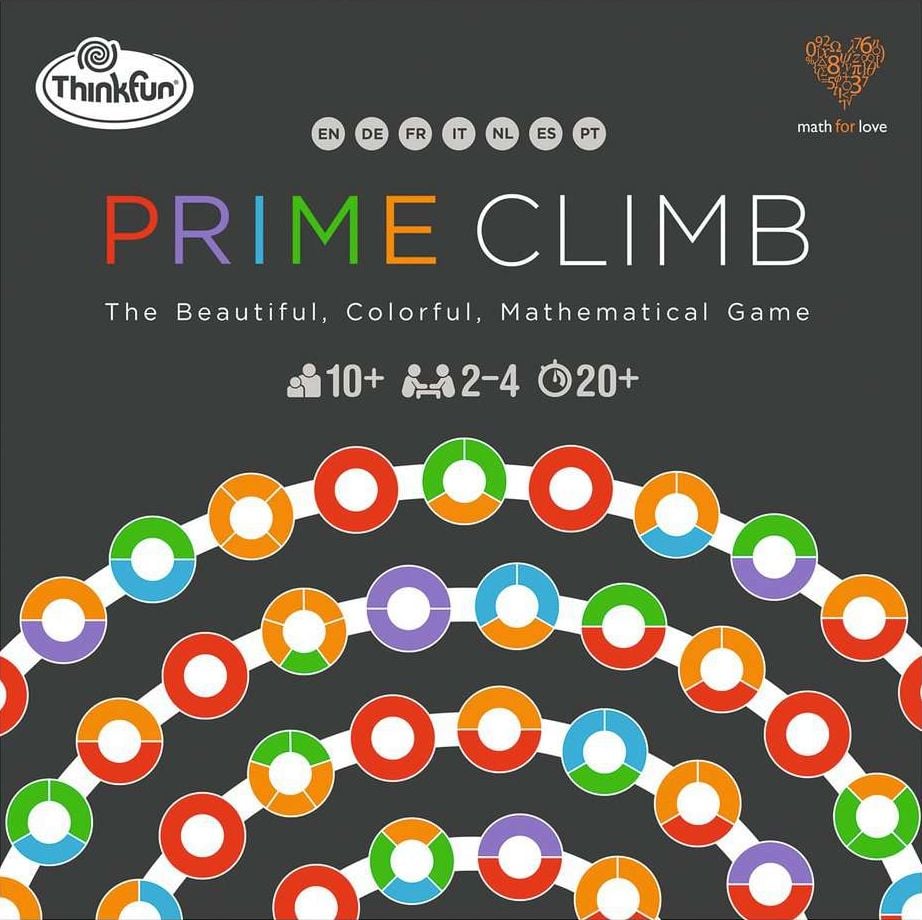
Prime Climb is a new board game that uses arithmetic to open a beautiful world of possibility. Players race to be the first to get to the center of the board while avoiding getting knocked back to the start by other players. Highlighting the power of the prime numbers, Prime Climb is mathematical, deep, creative, and fun. Each player controls two pawns that start at the 0 circle. Players take turns rolling two 10-sided dice and applying the values to their two pawns using any of the four basic arithmetic operations: addition, subtraction, multiplication, and division. The first to get both pawns into the 101 circle exactly wins the game! Be careful: if another player lands on you, you get sent back to the start. Along the way, players who land on the red circles collect Prime cards-some are helpful now, some are helpful later, and a few are trouble! One of the great innovations of Prime Climb is the coloring scheme. Each of the prime numbers less than 10 has its own color: 2 is orange, 3 is green, 5 is blue, and 7 is purple. After 10, each prime number is red. Any number that is not a prime is a mix of colors that corresponds to its prime factors. For example, 14 = 2 x 7, so the 14 circle is half orange and half purple. The color coding allows players a way to quickly analyze the factors and multiples of the numbers on the board. This helps players check their multiplication and division, and even allows kids who haven't yet learned multiplication to play the game.
Watch first





All videos













8 of 10
Creators who cover this

Math For Love
3 videos of this game

Sarah Melo
2 videos of this game

Grommet
1 video of this game

Homeschool 4 Real Life
1 video of this game

Kreative Leadership
1 video of this game

Leah K
1 video of this game

LittleLadyPlays
1 video of this game

Nowshin
1 video of this game
Games like this


2022John D. Clair
- Videos
- 103
- Creators
- 86
Mainly reviews and unboxings
2 - 9 players45 - 60 min1.3 weight

2024Stefan Feld
- Videos
- 90
- Creators
- 58
Mainly reviews and playthroughs
1 - 4 players90 - 180 min4.3 weight

2011Stefan Feld
- Videos
- 79
- Creators
- 61
Mainly reviews
2 - 4 players30 - 90 min3.0 weight
About Prime Climb
From BoardGameGeek:
Designers
Katherine Cook (I), Dan Finkel
Artist
Shawn Kemna
Categories
EducationalMathNumber
Mechanics
Dice RollingTrack Movement